
S.O.S. AFRAKA

ISSUE 24
A Cry from the Children of the Sun to the Sleeping Giant - Afraka
An S.O.S. is not a song composed for entertainment. It is a signal sent from a place of danger. It means that something precious is drifting, burning, sinking or disappearing—and those who can still hear must rise.
Editorial Note on the 2019 Moment
This article was first written in 2019, during a tense period in Nigeria’s public life. At the time, human-rights activist, journalist, former presidential candidate and founder of Sahara Reporters, Omoyele Sowore, had been arrested by the Department of State Services after calling for the nationwide #RevolutionNow protests over the social and economic condition of the people. Amnesty International later declared Sowore and Olawale Bakare prisoners of conscience and described the treason charges brought against them as unfounded. Sowore was eventually released on December 24, 2019, after months of detention, and the Federal Government withdrew the treason charges in February 2024. (Amnesty International, 2019; Robert F. Kennedy Human Rights, 2020; Amnesty International Nigeria, 2024)
The reader should therefore understand that the sentence “Sowore is still in jail” belongs to the living fire of that 2019 moment. It is preserved here in context, not presented as a description of the present day.
This expanded edition retains the original alarm, mystical force and demand for awakening, but it also corrects claims that cannot survive careful historical or scientific examination. If we seek to awaken Af’raka, we must be willing to awaken even from the stories that flatter us. A lie does not become sacred merely because it praises Black people. Falsehood wearing African beads is still falsehood.
Now, let us begin.
1. NIGERIA IN 2019: THE NATION WAS CRYING, BUT THE TELEVISION WAS LOUDER
It is a strange privilege to be alive in a time when serious things are happening everywhere, yet many people behave as though the greatest national emergency is the eviction of a contestant from a television game show.
The road is broken, the graduate is unemployed, the hospital is tired, the farmer is afraid, the teacher is underpaid, the trader is drowning in expenses, the young artisan is looking for capital, and a citizen is being detained after demanding accountability—but please, let everybody keep quiet for a moment because somebody in a brightly decorated house has quarreled over food.
Apparently, the nation can wait until after eviction night.
Do not misunderstand me. Entertainment is not a crime. Laughter is medicine, and the human mind needs rest. A people under pressure deserve music, sport, films, comedy and harmless pleasure. Even the mystic must sometimes laugh, unless he wants his face to become so serious that children begin to confess sins whenever he enters the room. Life is not meant to be lived with the forehead permanently folded.
But there is a difference between entertainment as rest and entertainment as anaesthesia.
Rest prepares you to return to your duty. Anaesthesia makes you forget that there is a wound.
The problem is not that the youth watched a television programme. The problem is that many appeared to have more emotional investment in the fortune of people they had never met than in the condition of the society in which they lived. The problem is not the show itself; it is the imbalance of attention. It is the spiritual disorder that makes a person memorize the quarrels, friendships, clothes and voting numbers of strangers while knowing almost nothing about the budget of his local government, the quality of the nearest school, the rights guaranteed by the Constitution or the name of the representative collecting a salary in his name.
Attention is spiritual currency. Wherever a people continuously place their attention, their emotional energy follows. Wherever their emotional energy goes, their collective world begins to form.
If the attention of a generation is permanently captured by spectacle, that generation may be physically awake while politically asleep. Its eyes are open, its data subscription is active, its fingers are moving very quickly on the phone, yet its higher mind is snoring.
The cage has Wi-Fi now.
Governance by Peanuts
The condition of society often resembles a poorly managed poultry farm. The political owners starve the chickens for a long time, then appear shortly before an election with a cup of grain. The hungry birds begin to dance around the farmer, not because the farmer loves them, but because hunger has shortened their memory.
One small bag of rice appears, and suddenly the road that disappeared for four years is forgotten. A little cash is shared, and the hospital without medicine receives instant forgiveness. A politician who could not remember the community’s name arrives in a convoy, waves through the window, calls everybody my beloved people, and the same people begin to cheer as though the Messiah has arrived with a police escort.
This is governance by peanuts.
It is a method that works only where poverty has been allowed to become a political weapon. When people are kept desperate, small gifts can be presented as miracles. What should have been a right begins to look like favour. The citizen is reduced to a beggar, and the public servant is enlarged into a king.
Yet the word is public servant. The official is meant to serve the public. Somewhere along the road, however, the servant entered an expensive vehicle, looked through the tinted glass and concluded that the public had become his domestic staff.
The suffering surrounding the 2019 moment was not merely an emotional impression. Nigeria’s National Bureau of Statistics later reported that 40.1 percent of the population—more than 82.9 million people—were poor according to the 2018/2019 national monetary poverty line, excluding Borno State from that estimate. The same survey reported a sharp rural-urban divide, with poverty much higher in rural communities. (National Bureau of Statistics)
These numbers represent human beings. Behind every percentage is a face. Behind every decimal point is somebody postponing a medical test, a mother reducing the quantity of food in the pot, a graduate returning from another failed interview, a child studying under conditions that make concentration itself an act of heroism.
Therefore, when an activist spoke about social and economic hardship, that concern did not fall from the sky. It arose from a visible national wound.
Who Was Sowore in This Story?

Omoyele Sowore was not a mysterious name invented by social media. He was known as a pro-democracy campaigner, journalist, founder of Sahara Reporters and a candidate in Nigeria’s 2019 presidential election. In August 2019, he was arrested after calling for the #RevolutionNow protests. Amnesty International stated that he and Olawale Bakare faced treason charges after demanding government accountability, and a later American Bar Association assessment concluded that the prosecution raised serious concerns about freedom of expression, peaceful assembly, due process and prosecutorial misconduct. (American Bar Association Center for Human Rights)
One does not have to worship Sowore, agree with every word he has ever spoken or accept every political method associated with him in order to understand the principle involved. An awakened person does not replace one cult of personality with another. The issue is larger than the man.
The issue is whether citizens may peacefully question power without being treated as enemies of the state.
The issue is whether the law is a shield for everyone or a staff used only by the strong against the weak.
The issue is whether public officials understand that criticism is not treason and that a nation is not the personal property of those temporarily occupying office.
The issue is whether young people can look beyond personality, tribe, party and emotion long enough to defend civic space itself.
If a government arrests a person you dislike for exercising a right, do not celebrate too quickly. The instrument used against your opponent today may be adjusted to your size tomorrow. Power rarely retires a weapon merely because its first target has fallen.
This is why the silence of influential people was troubling. Celebrities possess something more powerful than beauty, fame or expensive clothing: they possess attention. A sentence from a popular entertainer may reach millions before a carefully researched newspaper editorial reaches ten thousand. That influence does not mean a celebrity must comment on every matter, nor does it make entertainers automatic experts in law, economics or public policy. But influence creates a moral opportunity.
When society is bleeding, a public figure can at least point toward the wound.
When rights are threatened, a person with a platform can encourage lawful awareness.
When citizens are distracted, an influential voice can remind them that voting for a contestant is not a replacement for civic participation.
Imagine possessing a trumpet loud enough to awaken a city and using it only to announce a new shoe. The shoe may be excellent, but the city is still burning.
The Spiritual Battle for Attention
Many people think spirituality concerns only incense, visions, candles, dreams and long garments. No. The control of attention is one of the deepest spiritual matters.
What you repeatedly watch enters the inner chamber of the mind. What you repeatedly discuss builds thought-forms. What a population continually rewards becomes stronger. The leaders of media, politics and commerce understand this very well. They compete for the eyes because the eyes are gates. They compete for the ears because the ears carry seeds into consciousness. They compete for outrage because an angry person clicks quickly and reflects slowly.
The awakened mind must therefore ask:
Who benefits from my distraction?
What serious matter disappears whenever a new scandal begins?
Why can I argue for three hours about a celebrity I do not know, yet I have never read one page of the law that governs me?
Why do I know the slogan of every political party but not the record of the candidates?
Why am I emotionally exhausted by online quarrels but have done nothing in my street, school, market, union, professional association or local community?
Social media can spread awakening, but it can also produce the illusion of action. A person writes ten furious posts, receives two hundred likes and sleeps as if he has repaired the nation. Meanwhile, the corrupt official also sleeps—perhaps more comfortably—because he has muted the notifications.
Outrage without organization is smoke. It rises, attracts attention and disappears.
Real civic work is slower. It involves learning, verifying, documenting, voting, attending, supporting, building, petitioning, observing, teaching, creating alternatives and refusing to sell one’s conscience for peanuts. It is not always glamorous. There may be no camera. Nobody may clap. But the invisible work of disciplined citizens is the foundation on which a visible transformation later stands.
The first S.O.S., therefore, is this:
AF’RAKA, RECLAIM YOUR ATTENTION. A PEOPLE WHO CANNOT GOVERN THEIR ATTENTION WILL SOON DISCOVER THAT SOMEBODY ELSE IS GOVERNING THEIR DESTINY.
2. DIVISIONS TODAY: WHEN IDENTITY BECOMES A BUSINESS
It is painful to look at a civilization whose memory contains greatness while its present is occupied by quarrels that make greatness difficult.
Every person wishes to create a future that rises above the past. In much of Af’raka, however, we sometimes behave as though the future is a small room where the arguments of yesterday must be repeated forever. Tribe against tribe. Region against region. Christian against Muslim. Believer against traditionalist. North against South. East against West. One wounded memory striking another wounded memory, while the people who profit from division sit quietly and count.
Division has become an industry.
There are politicians whose careers would collapse if citizens stopped hating one another. There are religious leaders whose influence depends upon keeping their congregation afraid of everyone outside the building. There are online personalities who manufacture tribal anger because anger generates engagement. There are foreign interests that prefer weak institutions and divided populations. There are local elites who blame every failure on outsiders while signing private agreements with the same outsiders behind closed doors.
The awakened mind must be mature enough to see all of these layers at once.
Colonial rule exploited and hardened divisions in many parts of Africa. That is true. But colonialism did not invent every human weakness. Greed, rivalry, betrayal, domination and fear existed before the colonial flag was raised. Foreign powers often found cracks and widened them. Postcolonial elites inherited some colonial structures and then preserved them because those structures served their interests. Ordinary citizens sometimes continued the cycle through prejudice, electoral violence, silence and the worship of ethnic champions.
Therefore, liberation cannot consist only of pointing one finger outward. When one finger points away, three bend toward the hand. This does not erase the crimes of empire. It simply restores our agency.
If the only explanation for every African problem is the white man, then we have accidentally declared the white man an eternal god: all-powerful, all-knowing, present in every council meeting, every corrupt contract, every family quarrel and every bad decision. I refuse to grant any race that kind of divinity.
History matters. Foreign interference matters. Unequal economic systems matter. But the choices of African leaders and citizens also matter. A complete analysis must have enough room for both injury and responsibility.
Nigeria, Biafra and the Pain Beneath the Slogan
The renewed call for Biafra did not arise from nowhere. It carries the memory of the 1967–1970 Nigerian Civil War, the terror of mass death and starvation, and continuing feelings among many people in the southeast that they face political exclusion, insecurity, unfair treatment and cultural contempt. One may disagree with separatism and still acknowledge the wounds beneath it. Mocking pain does not heal a nation. Silencing grievance does not create unity; it merely forces grievance underground, where it learns to speak through anger.
But pain must not be allowed to dismiss reason.
A new flag does not automatically create a new political consciousness. A boundary can change while corruption remains seated comfortably inside it. The anthem can change while the same greed sings the chorus. The colour of the passport can change while the political culture remains exactly where it was.
If people carry the old chains into a new country, they have not founded a promised land. They have merely relocated the prison yard.
This is why every movement for self-determination must answer serious questions. How will it protect dissent? How will it treat religious and ethnic minorities? How will it prevent a new elite from replacing the old elite? What institutions will restrain power? What economic plan will create dignity? What happens to citizens who do not agree? Will women be fully represented? Will the poor gain a voice, or will wealthy men simply acquire new titles?
A liberation movement that cannot tolerate questions is already rehearsing oppression.
The original article connected Biafran agitation with Judaism as though the entire project sought to create a Jewish state. That statement is too broad. There are Igbo communities and individuals who practise Judaism, and some Igbo nationalists use Jewish or Israelite parallels when explaining identity, persecution and survival. Scholars have examined how such analogies function within postcolonial Nigerian ethnonationalism. But this does not mean that all Igbo people, all Biafran supporters or even most people in the southeast seek a Jewish state. (Cambridge University Press, Nationalities Papers)
Truth requires distinction.
Judaism, Christianity and Islam were also not manufactured by one modern British authority. Judaism developed in the ancient Near East over a long historical period. Christianity emerged from a first-century Jewish setting. Islam arose in seventh-century Arabia. Empires, states, missionaries, merchants and rulers later used religions in different ways—sometimes for service, learning and community; sometimes for conquest, legitimacy and control. To say that powerful institutions have used religion politically is reasonable. To say that one recent nation secretly invented all three traditions is not history; it is a story that saves us from the harder work of studying history.
And the harder work is where freedom begins.
Unity Is Not Forced Sameness
Many people shout, “One Nigeria!” as if a slogan can repair injustice. Others shout, “Separation!” as if a new map can cleanse the human ego. Both sides can become prisoners of simple answers.
A nation cannot be kept together by force and still call that condition unity. At the same time, division does not automatically produce justice. Unity is not the absence of disagreement. It is the presence of fair rules, shared dignity, mutual protection and the freedom to speak without fear.
The same principle applies to Af’raka as a whole. Pan-African unity must not mean that every African thinks alike, worships alike, dresses alike or interprets history in the same way. That is not unity; that is uniformity, and uniformity is often the favourite clothing of control.
Real unity is deeper. It says:
- Your tribe does not have to disappear for mine to be safe.
- Your language does not insult mine by existing.
- Your faith does not need state power to prove its truth.
- Your criticism of my leader is not hatred of my people.
- Your pain deserves a hearing even when your proposed solution is not mine.
- Our ancestors may have walked different paths, yet the same earth carried their feet.
The mystic understands that separation is useful on the physical plane but incomplete on the plane of consciousness. Bodies are separate. Languages are separate. Nations and histories are distinct. Yet life moves through all. The same breath visits the Muslim, the Christian, the traditionalist, the atheist and the child who has not yet learned any of those names.
When the body is wounded, the left hand does not refuse to help because the injury occurred on the right. It recognizes one life beneath different limbs.
Af’raka must learn this sacred anatomy.
We can honour Igbo pain without hating Hausa people. We can defend Muslim citizens without surrendering criticism of religious extremism. We can expose abuses committed by Christian institutions without insulting every Christian. We can restore traditional spirituality without forcing it upon those who choose another path. We can remember colonial crimes without converting memory into racial hatred.
If our awakening produces a new group of people we are permitted to despise, then we have not awakened. We have only changed the costume of sleep.
The second S.O.S. is therefore this:
AF’RAKA, DO NOT ALLOW YOUR WOUNDS TO BECOME THE KNIVES WITH WHICH YOU CONTINUE TO CUT YOURSELF. STUDY THE PAIN, SPEAK THE TRUTH, BUILD JUSTICE—BUT DO NOT WORSHIP DIVISION.
3. RELIGION TODAY: THE TEMPLE, THE MIND AND THE MARKETPLACE OF FEAR
Brothers and sisters, it is time to look at religion with open eyes.
Some will become nervous at once. The moment you ask a serious question about religion, somebody behaves as though God has appointed him personal security officer of the universe. He begins to defend the Almighty with insults, threats and capital letters.
One wonders how an omnipotent God became so helpless that a human being with a social-media account must fight on His behalf.
But questioning religion is not the same as hating religious people. Criticizing a church institution is not the same as insulting every Christian. Examining Islamic history is not an attack on every Muslim. Reclaiming African traditions is not permission to persecute those who choose another faith.
The goal is awakening, not replacement domination.
The colonized mind says, “My master alone must rule.” The awakened mind says, “No master—foreign or local, ancient or modern—may remove my conscience.”
The Physical Chain and the Mental Chain
Our ancestors experienced enslavement, dispossession, colonial violence, cultural humiliation and the destruction or weakening of many institutions. Missionary work was sometimes tied to colonial structures, and certain religious teachings were used to condemn African spiritual practices, names, images and customs. Some converts were taught to see their ancestors only through the language of demons. In many places, the Bible arrived beside the flag, the classroom and the administrative order.
This history must be studied without fear.
Yet history is more complex than the idea that Christianity is simply “the white man’s religion.” Christianity had deep African roots long before modern European colonialism. The Aksumite kingdom in Ethiopia adopted Christianity in the fourth century, and ancient Christian communities flourished in Egypt and other parts of North and Northeast Africa. (The Metropolitan Museum of Art) Islam also became woven into African intellectual and cultural life over many centuries; by the fifteenth and sixteenth centuries, Timbuktu was a major spiritual and scholarly centre of Islam, known for its mosques, manuscripts and schools. (UNESCO World Heritage Centre)
These facts do not erase conquest, coercion or the destructive use of religion. They simply prevent us from replacing one false history with another.
The real spiritual problem is not the geographic origin of every idea. The real question is: What does the idea do inside the human being and within society?
Does it expand compassion or shrink it?
Does it encourage truth or punish inquiry?
Does it strengthen dignity or demand self-hatred?
Does it inspire service or enrich an untouchable priesthood?
Does it help the believer face reality or teach him to escape responsibility?
A teaching does not become evil merely because it crossed a border. Mathematics crossed borders. Crops crossed borders. Languages, music, medicine and technology crossed borders. Likewise, an African practice does not become wise merely because it is indigenous. Every tradition must pass through the fire of conscience, evidence, justice and the highest good.
Return to the root—but inspect the root. A tree may inherit nourishment, and it may also inherit disease.
When Faith Becomes an Escape from Work
There is a form of religion that gives courage to the oppressed, feeds the hungry, educates children, cares for the sick, disciplines the ego and calls power to account. Such faith has served humanity.
There is another form that teaches the poor to finance the luxury of the preacher, teaches citizens to wait for angels to repair institutions, turns every health problem into witchcraft, turns every political failure into prophecy and turns every question into rebellion against God.
That form of religion is not awakening. It is sedation with a choir.
Prayer has value when it aligns the mind, purifies intention, strengthens courage and opens the conscience to wise action. But prayer becomes a hiding place when it replaces the action already within our power.
You cannot pray a road into existence while stealing the road budget.
Holy oil cannot lubricate a broken power grid.
Speaking in tongues does not excuse refusing to study the policy written in plain English.
A fasting programme cannot replace a functioning hospital, and a prophecy cannot perform the work of a trained engineer.
The Divine may inspire human beings, but inspiration still needs hands. A vision of a bridge is not a bridge. Somebody must calculate, design, fund, build, inspect and maintain it. If every step is neglected and the structure collapses, do not blame demons for what corruption and incompetence have explained very well.
This is where mental slavery becomes subtle. The chain is no longer around the ankle. It is tied around responsibility. The enslaved mind waits for permission, waits for a saviour, waits for a miracle, waits for a prophet, waits for a political messiah and waits for heaven—while life itself waits for the human being to stand.
The mature mystic does not deny the invisible. He simply refuses to use the invisible as an excuse for neglecting the visible.
More Temples, But Where Is the Transformation?
It is often said that we have more pastors than professors, more churches than schools and more preaching than industry. Such statements are usually rhetorical, not verified national statistics, and we should not pretend otherwise. But the frustration beneath them is understandable. Religious buildings and religious speech are highly visible in many communities, while classrooms, laboratories, libraries, factories, clinics and public infrastructure remain painfully weak.
The question is not whether a church or mosque should exist. The question is what a society reveals through its priorities.
If a congregation can raise millions for a new auditorium but cannot create a scholarship for one brilliant child, what exactly is being worshipped?
If a religious leader owns several cars while members cannot afford basic medicine, has prosperity arrived—or has it merely chosen one address?
If a nation prays every week against corruption but celebrates corrupt wealth at weddings, funerals and title ceremonies, the prayer is fighting a culture the worshippers continue to feed.
The problem is not only the pastor. The congregation also has responsibility. Many people do not want a teacher; they want a magician. They do not want discipline; they want shortcuts. They do not want to build value; they want somebody to “declare” wealth over them before Monday morning. Then the clever preacher studies the appetite of the crowd and opens a spiritual restaurant.
Today’s menu: instant miracle, express promotion, enemy destruction and a special seed for people who cannot wait for natural law.
The price, naturally, will be announced after the sermon.
We must criticize exploitation without pretending that every religious leader is a thief. There are sincere pastors, priests, imams, scholars and lay believers who serve their communities, defend human dignity and live modestly. Truth must remain fair even when anger is hot. If we condemn every member of a group for the abuse of some, we reproduce the same ignorance we claim to oppose.
The awakened person judges conduct, not labels.
Sacred Text, Symbol and the Error of Lazy Certainty
The original article claimed that holy books are 60 percent distorted African history and 40 percent allegory. There is no responsible way to prove such an exact division. Sacred texts are not bags of rice to be divided with a measuring cup.
The Bible, for example, is a library of writings produced and edited across different periods. It contains law, genealogy, poetry, wisdom, prophecy, narrative, gospel, letters, parable and apocalyptic symbolism. Different books demand different kinds of reading. Scholars debate the history, composition, transmission and meaning of many passages. The presence of metaphor does not make an entire text false, just as the presence of history does not make every line literal.
The spiritual error begins when a reader treats every symbol as newspaper reporting.
Mystical teachers across cultures have used stories because stories carry layered meaning. A desert may be geography, but it can also symbolize spiritual dryness. Egypt may refer to a place, but in a mystical reading it may also represent a state of bondage. An exodus may describe movement, but it can also become the soul’s journey out of ignorance. Death and rebirth may refer to physical events, yet they can also describe the ending of the lower self and the awakening of a higher consciousness.
To read symbolically is not to invent any meaning one desires. Symbols require context, discipline, language, comparison and humility. Otherwise, every imagination becomes a revelation, and ignorance begins wearing the crown of esotericism.
There is no awakening in replacing religious literalism with mystical carelessness.
The 666 Error: A Necessary Cleansing of the Mind
The original article also repeated a claim that Black skin is uniquely formed from six protons, six neutrons and six electrons, and that the number 666 in Revelation was therefore a hidden attack on Africans.
That claim is scientifically and historically false.
Carbon has atomic number six, meaning every carbon atom has six protons. A neutral carbon atom has six electrons, and the common carbon-12 isotope has six neutrons. But carbon is present in all human beings and throughout life; it is not a special chemical signature possessed only by Black skin. Human skin colour is chiefly connected to melanin and the way pigment is produced and distributed. People with darker skin generally produce more melanin—not a different set of carbon atoms. (Royal Society of Chemistry; Cleveland Clinic)
Likewise, serious study of Revelation 13:18 connects 666 with ancient number symbolism known as gematria. A widely discussed interpretation relates the number to Nero Caesar, and some early manuscripts even contain the variant 616. Whatever theological interpretation one prefers, there is no sound textual basis for saying the number identifies the Black race. (Bible Odyssey, Society of Biblical Literature)
Why include this correction so openly?
Because awakening must be honest.
If we reject European propaganda but embrace African propaganda, we are not free. If a statement praises us and we accept it without checking, while demanding ten documents for every statement that challenges us, ego—not truth—is governing the temple.
The truth does not need false science to defend Black dignity.
Black skin is worthy without a secret atomic code.
African people are human without needing to be declared a superior species.
Our history contains greatness without requiring every invention on earth to be falsely attributed to us.
Maturity is the ability to celebrate what is true and release what is not, even when the falsehood once made us feel powerful.
This is the discipline of the Light Bearer. Light exposes the lies told against us, but it also exposes the lies we tell ourselves. The same lamp must face both directions.
Christ Consciousness and the Institution
There is a difference between the consciousness associated with the teachings of love, mercy, courage, sacrifice and inner transformation, and the political machinery that may later grow around a sacred name.
One may criticize a church and still honour compassion. One may reject dogma and still recognize the wisdom in love your neighbour. One may study how religious institutions accumulated power without denying the sincere spiritual experience of ordinary believers.
What I call Christ Consciousness is not the ownership of a religious corporation. It is the awakening of sacrificial love, truth, moral courage and unity within the human being. A person may shout “Jesus” all day and remain far from that consciousness. Another may never use the term yet express its quality by feeding the hungry, defending the oppressed and forgiving an enemy.
Names are containers. Consciousness is the water.
People often fight over containers while dying of thirst.
The third S.O.S. is therefore this:
AF’RAKA, QUESTION EVERY TEACHING THAT MAKES YOU HATE YOURSELF, SURRENDER YOUR REASON OR ABANDON YOUR DUTY. BUT DO NOT REPLACE RELIGIOUS FANATICISM WITH ANTI-RELIGIOUS FANATICISM. FREEDOM OF MIND MUST INCLUDE FREEDOM OF CONSCIENCE.
4. WHO WILL SAVE AF’RAKA? THE MYSTERY OF SELF-RESCUE
Who will save Af’raka?
Some wait for a politician. Some wait for a prophet. Some wait for a foreign investor. Some wait for a military strongman. Some wait for Jesus to appear in the clouds. Some wait for the ancestors to become angry enough to repair the roads at midnight.
Everybody is waiting.
Meanwhile, the future is looking at the clock.
Sorry to disappoint those who enjoy passive hope: no saviour will do for a people what that people continuously refuse to do for themselves.
This does not mean that the Divine is absent. It means that Divine intelligence often moves through awakened human conscience, disciplined hands and courageous community. The farmer prays, but still plants. The healer invokes wisdom, but still learns the medicine. The student asks for illumination, but still opens the book. The citizen desires justice, but still organizes, votes, documents, speaks and builds.
The spiritual law is not sit down and be rescued. It is align, awaken and act.
If you ask the universe for harvest while refusing to place seed in the soil, do not accuse the cosmos of wickedness when the field remains empty. Even the rain needs something to meet underground.
The God Outside and the God Within
Many people have been trained to imagine God only as a distant ruler in the sky. They raise every petition upward while ignoring the small voice within that has been instructing them for years.
Leave the corrupt association.
Study the subject.
Apologize.
Begin the work.
Refuse the bribe.
Tell the truth.
Protect the child.
Join with others.
But the person ignores every inner instruction, enters trouble, then raises a louder prayer asking the heavens to cancel the consequences.
The Divine is not a clerk employed to erase every result of human irresponsibility.
The God within is conscience, intelligence, creative will, compassion and the capacity to choose. The God without is the living order expressed through nature, relationship, cause and effect, community and the larger field of existence. When the inner human aligns with the higher law, prayer becomes action and action becomes prayer.
An awakened people do not merely ask for a better country. They begin to embody the qualities from which a better country is formed.
Mental Sleep and the Love of Chains
In order to awaken, one must first admit that one has been asleep.
This is difficult because the ego prefers to believe it already knows. A person may defend the very teaching that diminishes him because familiarity feels like safety. A bird born in a cage may regard the sky as dangerous. The cage provides food at a fixed time. The cage has a familiar corner. The cage demands no knowledge of wind.
Freedom, on the other hand, requires wings.
Many Africans possess the key to at least one mental chain but keep polishing the chain because it was inherited. They say, “My father wore this chain, my grandfather wore this chain, therefore this chain is holy.” They decorate it with scripture, tribe, party colour or ethnic memory. Then they become angry at anyone who asks why a sacred inheritance is preventing movement.
An inherited belief may contain wisdom. It may also contain fear. Honour your ancestors, but remember that your ancestors were human beings learning within their own time. True honour is not blind repetition. It is continuing their search for truth with the tools now available to you.
We must awaken from:
- the belief that a powerful man is above the law;
- the habit of voting only by tribe or religion;
- the worship of unexplained wealth;
- the idea that criticism of a leader is hatred of his ethnic group;
- the belief that prayer excuses poor planning;
- the fear of books that challenge our opinions;
- the habit of blaming every outsider while protecting every local oppressor;
- the craving for instant wealth without service, skill or patient creation;
- the idea that a new nation, new church, new prophet or new party can save an unchanged mind.
The deepest revolution is not the replacement of one person at the top. It is the transformation of the consciousness from which leaders, institutions and citizens arise.
If we remove a corrupt ruler but continue to admire corruption in our families, workplaces and communities, another corrupt ruler will soon appear. He will not need to come from abroad. We will manufacture him locally.
Af’raka’s Spiritual Identity
To call Af’rakans the Children of the Sun is not merely to speak about skin. It is to speak about illumination.
The sun does not ask permission to shine. It does not become smaller because clouds gather. It gives life without demanding that every tree bear the same fruit. It touches palace and village, believer and unbeliever, river and grave.
To awaken as Children of the Sun is therefore not to announce racial superiority. Superiority is the language of an ego that has not healed. Our task is greater: to recover dignity without creating a new contempt, to restore memory without manufacturing myths, to build strength without becoming cruel and to honour difference without surrendering unity.
African spiritual traditions often understand life through relationship: the visible and invisible, the living and the ancestors, the individual and the community, the human and the land. The popular principle expressed in the word Ubuntu—that a person becomes fully human through other people—captures one stream of this wider relational wisdom.
Yet what do we practise today?
The leader steals from the community and says he is successful.
The businessperson cheats the customer and thanks God for profit.
The family protects an abuser to preserve its name.
The congregation celebrates wealth without asking how it was acquired.
The citizen throws refuse into the drain, then curses the government when the street floods.
We speak of oneness but behave as isolated appetites.
Spirituality that never enters economics, politics, family conduct, education and care for the earth is only decoration. The aura may be bright in the imagination while the character remains dark in practice.
Ascension is not escape from society. It is the raising of consciousness within society.
No Hatred Can Lead Us Home
Af’raka must embrace herself. We must study our histories, languages, philosophies, sciences, art, governance systems and spiritual traditions. We must restore what was deliberately damaged and recover what we ourselves neglected.
But return must not become revenge.
If colonial racism taught that whiteness was superior, liberation does not require us to declare Blackness superior. It requires us to destroy the ladder on which human worth is arranged by colour.
The white child living today did not personally design every colonial policy. The Black child living today is not personally guilty of every betrayal committed by an African ruler centuries ago. Historical systems have consequences, and those consequences must be repaired. But inherited identity is not automatic personal guilt.
We can demand restitution, fairness and truth without teaching hatred.
We can condemn white supremacy without inventing Black supremacy.
We can name European crimes without ignoring African collaboration.
We can honour our ancestors without lying about the past.
Love does not mean forgetting injustice. Love means seeking justice without becoming possessed by the spirit of the injustice we oppose.
This is not weakness. Revenge is easy; transformation requires strength.
The fourth S.O.S. is therefore this:
AF’RAKA, NOBODY WILL SAVE YOU WHILE YOU ABANDON YOUR OWN HANDS, MIND, MEMORY AND CONSCIENCE. THE LIGHT YOU SEEK MUST BECOME CONDUCT. THE PRAYER YOU SPEAK MUST BECOME WORK.
5. THE S.O.S. COVENANT: FROM AWAKENING TO ACTION
An article that only makes people angry has not completed its work. Anger may announce that a boundary has been crossed, but anger is a poor architect. It can break a door and still have no idea how to build a house.
Therefore, what does awakening require in practical terms?
1. Reclaim Your Attention
Choose what enters your mind. Enjoy entertainment, but do not allow it to consume every hour meant for growth. For every hour spent discussing spectacle, give time to reading history, understanding public policy, learning a skill, studying local problems or supporting meaningful work.
Attention is a vote cast every moment.
2. Verify Before You Share
Do not forward every attractive claim because it sounds revolutionary. A false claim about 666, history, race or secret control may generate excitement, but it weakens the larger message when exposed.
Ask for the source. Read beyond the headline. Compare accounts. Distinguish evidence, interpretation, belief and metaphor. A screenshot is not a manuscript. A confident voice is not proof. A person does not become a historian because he owns a ring light.
3. Defend Civic Space Peacefully
Know your basic rights. Support lawful, nonviolent participation. Document abuse carefully. Protect journalists, activists and ordinary citizens from arbitrary treatment, even when you disagree with them. The freedom you defend for an opponent is the freedom most likely to remain available to you.
4. Demand Institutions, Not Messiahs
Charismatic leaders come and go. Strong institutions protect society beyond the life of one hero. Ask about courts, electoral systems, schools, local government, health services, budgets, procurement, policing and public records.
A nation that depends on one good man is one heartbeat away from crisis.
5. Refuse Tribal and Religious Manipulation
When a politician suddenly remembers your tribe during election season, ask what he did for your community while in office. When a preacher says all outsiders are enemies, ask who profits from your fear. When a separatist or nationalist says questions are betrayal, ask what kind of freedom fears examination.
6. Honour Faith, But Reject Exploitation
Let Christians be Christian, Muslims be Muslim, traditionalists be traditionalists and nonbelievers follow conscience, provided no one uses power to harm another. Critique fraud, coercion, misogyny, violence and anti-intellectualism wherever they appear.
Religious tolerance does not mean intellectual surrender. It means disagreement without dehumanization.
7. Restore African Knowledge Honestly
Teach the history that slavery did not begin. Study Kemet, Nubia, Aksum, Mali, Songhai, Great Zimbabwe, Benin, Kongo and the countless peoples whose knowledge cannot be reduced to a few famous kingdoms. Study African philosophy, metallurgy, architecture, agriculture, medicine, art, mathematics, astronomy, trade and law.
But do not turn restoration into fantasy. Our ancestors achieved great things and also made mistakes. Their humanity does not reduce their greatness; it makes their achievements real.
8. Invest in Living Communities
Support libraries, apprenticeships, farms, workshops, laboratories, clinics, local journalism, cultural archives, mental-health services, women’s safety, child protection and responsible technology. Awakening needs structures through which wisdom can become daily life.
The future cannot eat slogans.
9. Hold Celebrities and Influencers to a Higher Possibility
Do not demand that entertainers become experts on everything. But encourage people with large platforms to use part of their influence for civic education, verified information and community support. Fame is not public office, yet fame can serve the public.
And if celebrities refuse, remember that the citizen still has a voice. A million small lamps can illuminate what one large spotlight ignores.
10. Begin with Your Immediate Circle
Do not wait to become president before practising justice. Pay workers fairly. Keep agreements. Refuse sexual exploitation. Do not bribe when another lawful path exists. Stop praising thieves because they share money at ceremonies. Teach children to ask respectful questions. Keep the street and compound clean. Help one person learn a useful skill.
The nation is an enlargement of everyday conduct.
11. Unite Without Erasing Difference
Build coalitions around shared needs: clean water, education, safety, jobs, justice and accountable government. A Muslim and a traditionalist do not need the same theology to demand a functioning hospital. An Igbo, Yoruba, Hausa, Ijaw, Tiv, Fulani, Ibibio or Edo citizen does not need to abandon identity to oppose corruption.
Cooperation is not the death of difference. It is the wisdom to recognize a common fire.
12. Become the Answer You Keep Requesting
If you pray for honest leadership, become honest where you lead.
If you ask for employment, build skill and support enterprises that create value.
If you desire unity, stop forwarding messages designed to inflame hatred.
If you ask for African dignity, treat African workers, women, children and strangers with dignity.
If you call upon the ancestors, live in a way that will not embarrass you when you join them.
This is self-rescue—not the worship of individualism, but the awakening of responsibility in each person so that collective action becomes possible.
THE FINAL ALARM: SHOULD WE GIVE IN, OR SHOULD WE RISE?
Af’raka, the hour is not asking whether you can quote beautiful words. The hour is asking whether you can become them.
You have spoken of freedom. Will you free your mind from propaganda, including propaganda that praises you?
You have spoken of unity. Will you stop turning tribe and religion into weapons?
You have spoken of spirituality. Will you allow spiritual truth to enter your wallet, workplace, vote, family and treatment of strangers?
You have spoken of ancestors. Will you study them honestly and become an ancestor worth remembering?
You have spoken of leadership. Will you practise integrity in the small territory already under your care?
You have spoken of awakening. Will you surrender the sweet sleep of excuses?
Nobody is coming to carry an entire continent into a promised land while its people refuse to walk. No politician, prophet, foreign government, celebrity or ancestral spirit can permanently rescue a consciousness committed to repeating the same habits.
The salvation of Af’raka is not a single event. It is a continuous discipline.
It is the teacher who refuses to abandon the child.
It is the journalist who verifies before publishing.
It is the judge who remembers justice when power enters the room.
It is the youth who learns a skill and teaches another.
It is the voter who refuses the peanut.
It is the believer who keeps faith without surrendering reason.
It is the traditionalist who honours the ancestors without exploiting fear.
It is the leader who sees office as service.
It is the woman who knows her voice is not a favour granted by men.
It is the man who understands that strength is protection and responsibility, not domination.
It is the citizen who can disagree without becoming an enemy.
It is the awakened soul who understands that Light without truth becomes fantasy, truth without love becomes cruelty, and love without action becomes a beautiful excuse.
The old chains were visible. The new chains live in assumptions, fears, loyalties, distractions and habits. This is why the present struggle is difficult: the prisoner may attack you for touching the chain because he has worn it long enough to mistake it for part of his body.
Still, we must continue to speak.
Not with hatred.
Not with invented history.
Not with racial pride that copies the disease of racial supremacy.
Not with religious persecution disguised as liberation.
We must speak with evidence, memory, courage, compassion and spiritual fire.
Af’raka does not need another master. Af’raka needs mature minds.
Af’raka does not need another marketplace of fear. Af’raka needs schools of thought.
Af’raka does not need citizens who only pray for change. Af’raka needs citizens whose prayer has entered their hands.
Af’raka does not need everyone to become the same. Af’raka needs different people awake enough to build together.
The S.O.S. has been sent.
The question is no longer whether the signal is loud enough.
The question is whether the Children of the Sun will remember that they carry Light.
SHOULD WE GIVE IN TO DISTRACTION, DIVISION, FEAR AND MENTAL BONDAGE? OR SHOULD WE COME TOGETHER, RISE, WORK, REMEMBER AND SHINE?
The answer will not be written only in what we say.
It will be written in what we become.
AWAKE, AF’RAKA.
RISE, CHILDREN OF THE SUN.
LET TRUTH BE YOUR LAMP, LOVE BE YOUR LAW, WISDOM BE YOUR GUIDE AND SERVICE BE YOUR PROOF.
Love and Light.
Written by Knight Fredel © 2019
Updated for magazine publication © 2026
READ ALSO:
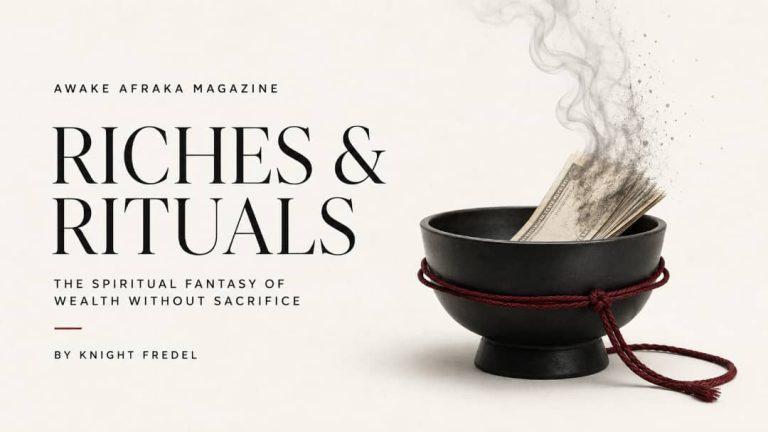
RICHES & RITUALS: THE SPIRITUAL FANTASY OF WEALTH WITHOUT SACRIFICE – BY KNIGHT FREDEL
THE OGBANJE CHILD: AND THE FOUR ELEMENTS – By Knight Fredel
LIKE ATTRACTS LIKE: A MESSAGE TO PARENTS AND ASPIRANTS – By KNIGHT FREDEL
Editorial Sources and Further Reading
- Amnesty International (2019): Human-rights defenders Omoyele Sowore, Olawale Bakare and Agba Jalingo
- Amnesty International Nigeria (2024): Withdrawal of treason charges against Sowore
- American Bar Association Center for Human Rights: Preliminary report on Sowore proceedings
- Robert F. Kennedy Human Rights: Timeline of Sowore’s detention and release
- Nigeria National Bureau of Statistics: Poverty and Inequality in Nigeria 2019
- Cambridge University Press: Jewish analogy, ethnonationalism and postcolonial Nigeria
- The Metropolitan Museum of Art: African Christianity in Ethiopia
- UNESCO: Timbuktu as an intellectual and spiritual centre
- Royal Society of Chemistry: Carbon
- Cleveland Clinic: Skin structure, melanin and pigmentation
- Bible Odyssey / Society of Biblical Literature: The Sign of the Beast