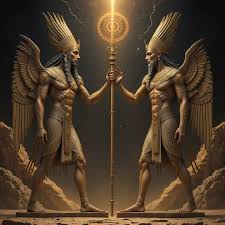

THE FORBIDDEN ARCHIVE: When Ancient Memory Refuses to Stay Buried

ISSUE 099
Written by Knight Fredel
...
There is something peculiar about ancient stories. They do not die. They simply change form.
No matter what, the knowledge they termed as forbidden would one day rise to the surface. You may burn libraries. You may smash statues. You may rename gods, redraw borders, rewrite school curricula, and announce that history has been “updated.” But stories; real ones, inconvenient ones, have an irritating habit of surviving. They slip through time in fragments. They hide in symbols. They linger in carvings that refuse to explain themselves. They survive in half-remembered songs, in fireside tales, in moonlit folklore whispered long after empires collapse.
History can be edited. Memory is harder to erase. Especially memories that pass on from one generation to the other through cultures or through certain spiritual traditions that make it mandatory to pass on such memories orally from master to student.
And now, my dear reader, I hope you are ready to embrace the uncomfortable truth. As a matter of fact, if I’m being honest... this is where the conversation begins to itch.
Because once you step outside the polite boundaries of modern education; once you walk past the tidy shiny modern timelines and into the ruins of ancient memory, you’ll begin to notice something strange:
Many different civilizations tell versions of the same story.
They are not united by the same religion. They do not share the same language.
Not even the same continent.
But all you’ll see is “the same pattern”.
Africans. Chinese. Native Americans. Sumerians. Mesoamericans. Egyptians. Civilizations that never held conferences together, if I’m being a bit witty, I’d say these are civilizations that never shared newspapers, never exchanged email addresses; yet somehow they speak of similar events:
Beings from the sky. Shining ones. Teachers of mankind who descended. Bringers of knowledge. Givers of law. Architects of civilization.
They speak of a time when humanity was not alone in its own beginning.
That repetition is not a small detail. It is either a remarkable coincidence, or a remarkable memory.
And if you dig deeper into this rabbit hole, the stories become even more unsettling. As a matter of fact, there are ancient stories suggesting that some African traditions speak of a time before the moon. Yes, before the moon. In several ancient narratives, the moon is described not as a natural companion, but as something that appeared suddenly. And shortly after its arrival, comes the tale of a great flood.
Now, pause.
The moon controls tides. Right?
Tides affect oceans. Oceans influence climate and catastrophe. Which means the moons arrival caused oceans to rise, and cities sent under water! Hold on?
Isn’t this why we have some cities and kingdoms which was said to have suddenly disappeared from our map? The lost city of Atlantis... Maybe? Which is now beneath the Atlantic ocean?
Oh no! My head spins... Wait, what? But hey... let us not sprint ahead of ourselves. That is a conversation for another chapter, or episode entirely because the rabbit hole runs deeper than you know it.
For now, observe the pattern.
Some cultures say these beings came from “heaven.”
Others say they came from the stars.
And there are the others too, who call it the realm of the gods.
Same sky. Different subtitles.
Before anyone reaches for their emergency theological response kit, allow me to clarify: this is not a dramatic declaration that “aliens built everything.” We are not rolling credits on human achievement.
What we are doing is asking a simple question:
Is it statistically reasonable that civilizations separated by oceans, languages, and centuries all invented the same cosmic storyline independently?
Either humanity shares a psychological glitch that spans continents and millennia, or something occurred in deep antiquity that we have spent more time arguing about than examining.
One explanation flatters our scepticism. The other challenges our certainty.
And certainty, as history has shown, is usually the first thing that needs revision.
Africa, the Uncomfortable Evidence, and the Art of Historical Amnesia

Here is the part that rarely makes it into polite textbooks. Africa is not just “the cradle of humanity.” It is also a graveyard of advanced unanswered questions.
Across the continent, there are:
Megalithic structures with engineering precision that still raises eyebrows.
Ancient sites whose construction methods are debated more than explained.
Symbol systems older than many recorded histories. Metallurgical and astronomical knowledge appearing earlier than expected. And then there are the stories.
Stories of beings who came from the sky.
Stories of teachers who brought law, science, and sacred knowledge to mankind.
Stories passed down not as fiction, but as ancestral memory.
Curiously, many of these artefacts and relics did not stay where they were found. They travelled; mostly in one direction. You know where... or don’t you?
Alright, fine, I’ll spill the beans... The Museums in Europe and America are very well-decorated with “former African property.”
Official explanation: preservation and research. Unofficial reality: control of narrative.
Because history is easier to manage when you own the evidence.
Why Monuments, Pyramids, and “Sacred Geometry” Keep Showing Up
Across different civilizations, we see repeating obsessions:
Pyramidal structures with its precise alignments with a certain star system.
Geometric patterns with ritualistic and symbolic meaning. And there are architectures that seem to care more about energy, alignment, and resonance than mere shelter.
Ancient people were not stupid. They just explained technology with the vocabulary they had.
If you showed a smartphone to a medieval peasant, you would not get a product review. You would get a miracle story.
So when ancient texts speak of:
Chariots of fire. Gods descending in light. Voices from the heavens. Or beings who ascend and vanish into clouds. The modern mind laughs while the technological mind pauses.
Only the honest mind continues to ask: How would pre-industrial humans describe advanced technology?
Answer: with poetry, fear, and religion.
Like I always say, a very advanced technology is indistinguishable from magic...
Now, let that sink in a bit...
Sky People; A Global Memory with Different Accents
We spoke boldly about ancestral stories.
Stories not told as fantasy; but as memory.
Stories of beings who came from the sky.
The shining ones.
The watchers.
The law-givers.
The teachers. And then we did something slightly irresponsible. We did not give examples.
So let us correct that.
Because if we are going to disturb comfort zones, we might as well do it with receipts. #winks
The Zulu and the People of the Stars
Among the Zulu, there are ancient traditions that speak of beings associated with the heavens and the origins of humanity. The high creator figure, Unkulunkulu, is described as the first ancestor; the great one who brought order and human life into form. But within broader Southern African traditions, especially among related groups like the San, there are persistent narratives of sky beings who interacted with early humans.
In certain Zulu oral accounts, there are references to beings who descended and instructed humanity in order, social structure, and survival. Not cartoon angels with wings; but powerful presences associated with the sky.

Move slightly west to the Dogon of Mali, and things become even more interesting. The Dogon speak of the Nommo; amphibious, luminous beings who came from the Sirius star system. According to Dogon cosmology, the Nommo descended in a vessel accompanied by wind and noise, bringing knowledge of astronomy, agriculture, and order.
Now here is the detail that tends to make anthropologists cough politely:
The Dogon possessed knowledge of Sirius B; a companion star invisible to the naked eye, long before modern telescopes confirmed its existence.
Coincidence? Cultural contamination? Oral brilliance?
The debate continues, but the pattern remains: beings from the sky. Teachers. Bringers of knowledge.
Not conquerors in every version; sometimes civilizers.
The Chinese: Dragons from the Heavens
In ancient Chinese tradition, the sky is not empty. It is populated. Chinese mythology speaks of the Tian; Heaven, not merely as a location but as a governing intelligence. Emperors ruled under the “Mandate of Heaven,” implying authority derived from celestial order.
Then there are the dragon beings. In the West, dragons are villains. In China, they are wise, powerful, sky-connected entities associated with rain, fertility, and cosmic balance.
One early culture hero, Huangdi, the Yellow Emperor, is described in legend as a being of celestial origin who descended, ruled, introduced governance, warfare techniques, medicine, and writing, and eventually ascended back to the heavens in a dragon-like craft.
He did not simply die; he departed.
And the people were left with knowledge systems that shaped civilization.
Japan: The Descent from Heaven
Japanese Shinto tradition tells of the Amatsukami; heavenly deities, and specifically the descent of Ninigi-no-Mikoto, grandson of the sun goddess Amaterasu.
Ninigi descends from the heavens to rule the earth, bringing with him sacred regalia; symbols of authority that still legitimize the Japanese imperial line today.
The imperial family traces its lineage back to this heavenly descent.
Not metaphorically.
Literally.
Heavenly origin. Political authority. Divine bloodline.
Notice how governance and sky lineage seem to be very good friends.
Sumer: The Anunnaki and Administrative Heaven
Now we arrive at Sumer; the civilization that wrote things down before everyone else got organized.
The Sumerians spoke of the Anunnaki; beings who descended from the heavens to Earth. Among them:
Enki, the wise one, associated with water, creation, knowledge.
Enlil, the authority figure, associated with command, air, and sometimes destruction.
According to Sumerian tablets, these beings established cities, taught agriculture, organized political systems, and structured civilization.
They did not appear as distant metaphors. They were described as present.
They argued. They issued commands.
They had agendas.
And in several texts, they are said to have come “from the heavens to the earth.”
It sounds poetic; until you realize it is repeated with administrative detail.
More on the Anunnaki beings soon, they have an entire edition meant for them, however, within this article we shall again talk about them because they.
Native Americans: The Star People
Among many Native American traditions, there are stories of “Star People.”
The Lakota speak of beings who came from the Pleiades. The Hopi speak of the Kachinas; spirit beings who descended, taught rituals, guided society, and promised to return.
In some traditions, these sky beings instructed tribes in agriculture, moral codes, and sacred ceremony. They were not worshipped as the ultimate Creator but revered as teachers.
Once again, notice the similarities in the stories:
Descent.
Instruction.
Departure.
Promise of return.
The narrative rhythm is familiar.
India: The Devas and the Architects of Order
In ancient Indian texts, particularly the Vedas and later epics, the Devas are celestial beings who interact directly with humanity.
They travel in vimanas; flying vehicles described with remarkable mechanical detail in some texts. They engage in wars in the sky. They wield weapons that sound suspiciously like advanced energy systems.
The god Indra descends.
Krishna instructs.
Various sages receive knowledge from higher beings. And once again, divine authority intersects with governance, war, morality, and cosmic law.
The Sanskrit word “deva” means “shining one.”
Shining ones. Does that phrase sound familiar?
Now, Let Us Be Uncomfortably Honest
Zulu. Dogon. Chinese. Japanese. Sumerian. Native American. Indian.
These are different continents, different languages, different climates, different cuisines. Yet they keep encountering; sky descent, shining ones, reachers of law and civilization, knowledge transmission, divine or semi-divine bloodlines. Then after they reach satisfaction, they depart or ascend back to the heavens, promising to come back again.
So, it is either humanity collectively developed the same imaginative hobby… Or we are looking at a shared archetype rooted in something deeper. At minimum, these stories suggest that early civilizations understood knowledge as something that came “from above.” At maximum; well, that depends on how brave you feel today.
Uniting the Pattern. Strip away the names. Remove the cultural decoration. Ignore the local costumes. What remains? A memory, a pattern as follows:
- Advanced beings arrive.
- They bring knowledge, law, and structure.
- They establish or influence civilization.
- They depart.
- They are remembered as gods, ancestors, or sky people.
The language differs. The architecture differs. The mythology differs. The structure does not. But, does this prove extra-terrestrial intervention? Well, to an extent. But, does it prove advanced ancient contact?
Yes, to an extent too.
Humanity has been telling the same sky story for a very long time. And when a story survives continents, centuries, colonization, religious edits, and academic discomfort, it deserves at least one thing: Serious attention; Not panic or blind belief. and that is because sometimes myth is not fantasy.
Sometimes myth is history wearing poetry. And sometimes; just sometimes, the reason it sounds impossible is because we are still measuring the ancient world with modern assumptions. And modern assumptions, as history repeatedly demonstrates, expire faster than milk in the sun.
When Myth Starts Behaving Like Memory
There is a dangerous idea hidden inside ancient traditions:
That humanity is not the first draft. Many old stories speak of previous ages. Lost worlds or the destroyed civilizations. Some talked about the great resets. Cycles of rise and collapse; Mu or Lemuria. Atlantis, Mayans. All the forgotten epochs. Even mainstream archaeology admits: civilizations have risen, fallen, and vanished more than once, and we are not the first.
We keep discovering buried cities, anomalous artefacts. Uncomfortable timelines and structures that don’t fit neatly into the historical boxes we have. Every generation likes to believe it is the beginning. They always believed they were the first and only ones here... but unfortunately, evidence keeps disagreeing. Across cultures, there is another recurring theme: the Watchers.
Not always called that. Sometimes they are: The shining ones. The gods; or the messengers.
What did they do? Well, according to ancient manuscripts, they arrive, they teach, they organize, they warn of impending dangers, then they leave. But, one thing the various historical stories have in common is that, just before they finally leave, they promise to return.
This is not unique to one religion or one continent. It is a global motif.
And once again, you have two options:
- Assume all ancient cultures independently invented the same cosmic fan fiction.
- Or accept that something unusual sits behind the consistency of the story.
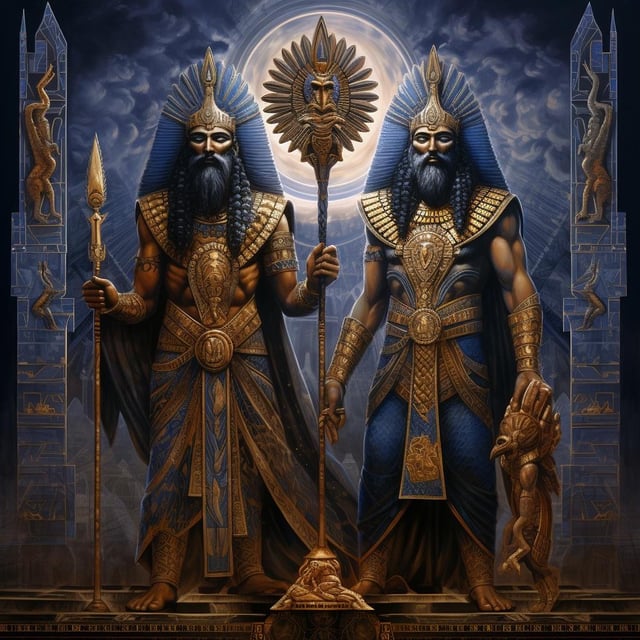
Now let’s step into the part of history that makes theologians nervous and historians very careful: Sumer. As mentioned earlier, the Sumerian texts speak of beings called the Anunnaki. Among them, two figures stand amongst the myth and controversy:
Enki – the wise one, the engineer, the teacher, the one with a serpent symbol, the giver of knowledge. Enlil – the commander, the authority figure, the enforcer of law, the god of war.
In these stories: One wants humanity to grow, learn, and evolve. The other wants humanity to obey, fear, and serve. If those dynamic sounds familiar, congratulations; you’ve read parts of the Old Testament.
This is where things get… complicated.
Because when you read ancient texts side by side, you begin to notice: Conflicting personalities attributed to “God”, contradictory moral commands. A strange split between mercy and massacre. Wisdom in one passage, brutality in another.
One tradition loves war. The other warns against it.
One demands fear. The other encourages knowledge.
And suddenly, the Bible stops looking like a single voice and starts looking like a compilation of older, competing traditions.
Let’s start with the “Fruit of Knowledge” and the Crime of Thinking... Right?
In the ancient narrative, knowledge is not neutral. It is political.
One side says:
Humans should not be taught too much. They are dangerous. They will destroy themselves.
The other side disagree and says:
Humans must learn. They must choose. They must grow, even if they fail many times.
Sound familiar?
The “serpent” in the garden is not just a villain in a children’s story. In older symbolism, the serpent is: Wisdom. Knowledge. Healing. Renewal. And... The cycle of life.
So when the story says:
“They ate from the tree of knowledge and were cast out,”
Here is another way to read it:
“They were removed from controlled ignorance and forced into independent thinking.”
Which, historically, has always been a punishable offense.
Now, let’s go even further, let’s talk about the floods, the great resets, or what I’d call the selective survival of the human civilization.
Almost every ancient culture has a flood story.
Not just one. Many. From Mesopotamia to Africa to the Americas to Asia.
Again, you can say:
Coincidence? Or could this be a memory of some repeated catastrophes...
Interestingly, in the Sumerian versions, it is Enki who warns humanity.
Not the war god. The teacher. The genetic engineer who made homo sapiens, thus the protector. Click here to see the previous article on GMO, there you’ll find my exposé on this subject.
And suddenly, after downloading some of this truth, the “Noah story” will begin to look less like a unique religious event and more like a retelling of a much older disaster narrative.
When the Sky Sat Down with Africa
Let us be very precise.
Africa does not whisper timid folklore. Africa tells stories like it is filing an official report.
When elders speak of sky beings, they do not lean forward and say, “Once upon a time.”
They say, “This is what happened.”
Now whether modern academia nods approvingly or clutches its footnotes is a separate matter entirely.
Let us walk through the accounts.
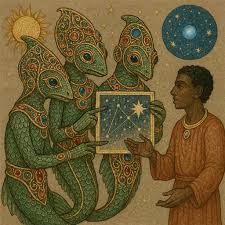
The Nommos — The Amphibious Visitors of the Dogon
Among the Dogon people of Mali exists one of the most controversial narratives in comparative mythology: the story of the Nommos.
Not vague spirits. Beings... And neither is this some poetic metaphors.
Described as amphibious, luminous, and associated with the Sirius star system; specifically Sirius B, a star invisible to the naked eye.
Now pause there.
Sirius B was confirmed by Western astronomers in the 19th century using telescopic technology. The Dogon tradition, documented in the 20th century, claimed knowledge of it long before telescopes entered their villages.
Convenient coincidence? Anthropological contamination? Or... perhaps an ancient memory?
Choose your preferred discomfort.
The Nommos are said to have descended from the sky in a spinning vessel accompanied by wind, thunder, and dust. They brought order. Knowledge. Structure. They reorganized humanity after chaos.
Notice the pattern again:
Descent. Instruction. Civilization management.
And here is the interesting detail: the Nommos are not conquerors. They are administrators.
They adjust things. As if Earth required calibration.
The Ariel School Encounter — When Children Pointed at the Sky
Fast forward to 1994. Ruwa, Zimbabwe.
Sixty-two schoolchildren reported seeing a craft descend near their playground. They described beings with large eyes, long dark hair, and tight black suits.
Children.
Not conspiracy theorists, YouTube commentators or aspiring documentary producers.
Children.
They spoke of telepathic communication. Environmental warnings. A sense of urgency. Now here is what makes this awkward. Children can fabricate stories. Certainly. But sixty-two children independently describing similar entities, similar messages, similar emotions?
That is either the most synchronized playground fiction in modern history; or something occurred that defies casual dismissal. And notice again: beings from the sky interacting directly with African witnesses.
The continent is not absent from modern encounters. It is simply underreported.
The Chitauri — The Zulu “Sky Gods”
Now we enter deeper waters.
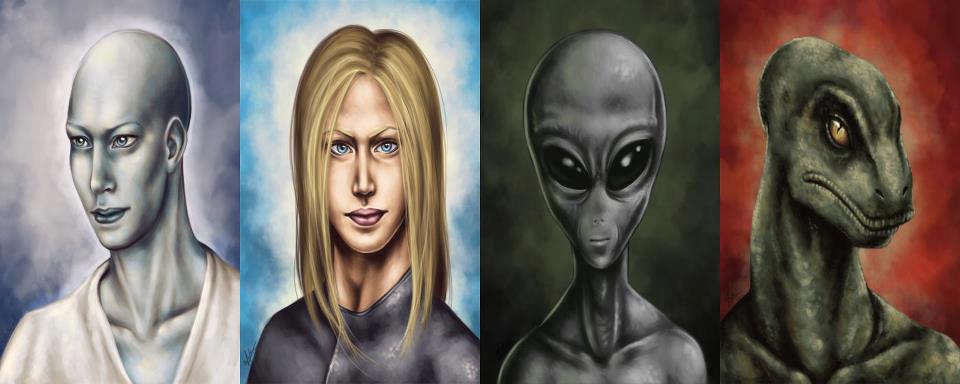
In Zulu cosmology, as articulated by figures like Credo Mutwa, we encounter the Chitauri; described as ancient, powerful beings associated with the sky. Sometimes reptilian in form. Sometimes shape-shifting. Often manipulative. They are remembered not as gentle teachers but as rulers. The word itself has been interpreted to mean “dictators” or “those who tell people what to do.”
That is not subtle symbolism. These beings are said to have influenced early leadership structures. To have shaped power systems. To have altered human development. Now, modern audiences hear “reptilian sky beings” and immediately imagine science fiction villains.
But, again... pause.
Strip away the cinematic filter. What remains is a cultural memory of non-human intelligences interacting with early societies, sometimes benevolently, sometimes not. Africa’s stories are not naïve. They acknowledge complexity. Some sky beings teach. Some rule. Some deceive. That is not mythology. That is political commentary wrapped in cosmology.
Afrofuturism — Reclaiming the Sky
Now let us pivot. Because Africa did not merely preserve ancient sky narratives. It reinvented them.
Enter Afrofuturism. Figures like Sun Ra declared he was from Saturn, not as delusion, but as artistic cosmology. A declaration that Black identity was cosmic, not confined.
Octavia Butler wrote extraterrestrials not as invaders but as mirrors; beings reflecting survival, adaptation, power, and transformation.
In Afrofuturist thought, “alien” becomes metaphor. Diaspora becomes interstellar displacement.
The sky is not invasion. It is ancestry. And that is profound.
Where ancient myths describe descent from the heavens, Afrofuturism flips the lens:
We are the star people. We were always cosmic. It is no longer about beings visiting Earth.
It is about reclaiming origin.
The Asteroid Belt and the Ghost of a Broken World
There is a long-standing scientific observation: between Mars and Jupiter sits the asteroid belt. Some theories suggest it is the remains of a planet that never fully formed, or one that did not survive.
Ancient traditions speak of a destroyed world. A lost home due to some catastrophic war which led to a migration. More on this on our next episode.
Science says, “Interesting coincidence.” But ancient memory whispers, “We’ve been here before.”
Let’s talk about their races, and their origins: Here is where things get sensitive, fast.
Ancient traditions speak of different groups, different lineages, different origins. Not in the modern racist sense, but in the mythic sense of multiple interventions, multiple migrations, multiple genetic stories. Modern society wants a clean, simple narrative but history rarely provides one. The danger is not in asking these questions. The danger is in weaponizing them.
Which is why serious discussion must always separate: Speculation from evidence. Myth from biology. And symbolism from politics. But ignoring the question entirely does not make it disappear. It only makes it someone else’s propaganda tool.
Presidents, Podcasters, and Carefully Worded Half-Truths
When a former U.S. president can casually say on a podcast:
- “Aliens are real, but I haven’t seen them,”
…that tells you something.
Not that disclosure is complete. But that denial is no longer fashionable because their tone has changed, and they are saying it. But are people listening? Or are we too busy arguing about trending scandals, viral distractions, and the daily circus of outrage?
Power, Bloodlines, and the Recurring Symbols of Rule
Across civilizations, certain symbols like the ones listed below keep reappearing:
Serpents
Dragons
Winged beings
Feathered serpents
Obsessions with immortality
“Divine right” bloodlines
Families claiming special origin stories
Different cultures.
Same imagery.
Same hierarchy.
This does not automatically mean “non-human rulers,” but it does suggest a long tradition of elites believing they are not the same as the masses. And where there is that belief, there is always:
Secrecy
Control systems
Ritualized power
And a deep fear of the public asking the wrong questions
So… Is Any of This “Proven”?
That depends on what you mean by proven. I mean, is religious history proven? No. Is theology proven? No. Is ancient myth proven? No.
But are there: ancient tablets? Yes. Lost cities? Yes. Advanced ancient engineering and technology? Yes. Repeating global myths? Yes. Historical inconsistencies? Yes.
The honest answer is:
- We have fragments of a very old, very complicated story—and we are still arguing about what genre it belongs to.
Final Thought: Life Is Bigger Than Religion, Smaller Than Arrogance, and Stranger Than We Planned Religion, at its best, is a symbolic language for mystery. At its worst, it is a cage for curiosity. Science, at its best, is a tool for discovery.
At its worst, it is a bureaucratic comfort blanket. And humanity, at its most honest, is a species still trying to remember where it fits in a universe that refuses to be simple. Alien disclosure: if it comes—will not just challenge science. It will challenge history, theology, power, and identity. Which is precisely why it has taken so long.
The universe is not in a hurry. But it is very persistent.
And it keeps leaving us clues, in the stone. In stories. In the sky. And in the uncomfortable spaces where certainty goes to die.
The Architecture of the Gods:
When Divinity Starts Looking Like Administration
Here is the part that usually makes people shift uncomfortably in their chairs and suddenly remember they have urgent appointments elsewhere.
God, as most people understand the word, is not wrong. It is just… incomplete.
The ancient understanding—older than churches, older than mosques, older than the committee meetings that decided which books were “in” and which ones were “dangerous”—did not speak of a lonely, bureaucratically overworked deity running the entire universe like a one-man customer service department.
It spoke of structure.
Two great principles. Two aspects of one ultimate source.
The Mother principle: the nurturer, the womb of worlds, the architect of life, the intelligence that births forms, ecosystems, consciousness itself.
The Father principle: the protector, the stabilizer, the preserver, the intelligence that defends, orders, and maintains the continuity of creation.
Not two competing gods. Not a divine soap opera.
Two sides of one cosmic intelligence—creation and preservation, expansion and structure, becoming and being.
And beneath this supreme source?
Administration.
Yes. Administration.
Because even the universe, it seems, does not run on vibes alone.
The Lesser Gods: Not Rivals, Not Equals—Functionaries
Ancient systems did not imagine a single god doing everything from gravity to heartbreak to crop rotation to moral accounting.
They imagined specialization.
There were intelligences responsible for:
Fate and destiny
Balance and order
Karma and consequence
Life in the oceans
Life on land
The cycles of nature
The thresholds between worlds
The maintenance of cosmic equilibrium
Not because the Creator was weak—but because complex systems require distribution of function.
If you need something, you don’t shout into the void and hope the entire universe rearranges itself just for you. You go through the appropriate channel—while still honoring the Source.
This is not polytheism in the childish sense. It is cosmic logistics.
Modern people hear this and say, “So you mean many gods?”
Ancient people would reply, “No. We mean many offices.”
The Old Mistake: When Managers Start Pretending They Own the Company
Here is where things historically go wrong.
Some of these “lower gods”—or, if you prefer a more uncomfortable word, advanced beings—did not stay in their lane.
Instead of acting as stewards, teachers, or custodians, some began to act like owners. They demanded worship. They demanded temples. They demanded fear. They demanded obedience. And so, they did something very human, very predictable, and very ugly:
They pretended to be the Source.
This is not a new story. It is the oldest political trick in existence:
Control the narrative. Claim absolute authority. Rewrite the origin story. Punish dissent. Reward loyalty.
Sound familiar? It should. We still do it; just with better suits and worse press releases.
Enki and the Dangerous Idea of Informed Humans.
In the ancient traditions, one figure consistently appears as the troublemaker—in the best possible way.
Enki; The teacher. The engineer. The giver of knowledge.
The one associated with the serpent symbol as his emblem; not as evil, but as symbol of wisdom, renewal, and understanding.
His crime?
He did not want humans to remain obedient livestock. He wanted humans to: Learn; Understand; Choose; Grow; Fail; Try again; And eventually mature into a self-aware civilization; He warned humanity about those who claimed to be the “only God.” He insisted that the true Source does not demand fear.
He taught that knowledge is not sin—it is responsibility.
Which, historically, has always been the most dangerous lesson you can give any population. Enlil and the Old Business Model of Fear Opposite this stands the archetype of Enlil—the commander, the enforcer, the authority figure, the god of war in many ancient texts. His model is simple and extremely popular with tyrants:
Humans must obey, fear, serve...
They must not know too much.
They must build.
They must sacrifice.
And theyt must kneel.
This is not the voice of cosmic wisdom. It is the voice of empire. And if you read certain sacred texts carefully—very carefully—you will notice something strange:
In one chapter, “God” sounds compassionate. In another, “God” orders total slaughter.
In one passage, mercy.
In another, genocide.
In one story, protection.
In another, punishment for existing in the wrong place.
That is not divine mystery.
That is multiple voices preserved under one title.
The Flood, the Warning, and the One Who Chose to Save.
In the older versions of the flood story—the ones that predate later religious edits—it is not the war god who saves humanity.
It is the teacher.
It is Enki who warns. It is Enki who defies the command to let humanity perish.
It is Enki who chooses preservation over punishment.
Which raises a question that theology often avoids: Why would a true, infinite, all-wise Source need to be argued with about saving its own creation?
Unless, of course, we are not talking about the Source at all—but about managers with conflicting agendas.
The Watchers: Observation, Not Worship
Ancient texts, including the Book of Enoch, speak of the Watchers.
Not gods. Not saviors. Not rulers. Observers. Their role is not to be prayed to. Their role is not to be obeyed. Their role is not to interfere.
They watch.
They record.
They report.
Think less “angels with harps” and more “cosmic field researchers.”
Which is far less comforting—and far more interesting.
Colonization, Then and Now: A Depressingly Familiar Pattern
Here is the part nobody likes to hear, because it hits too close to home.
If modern humanity were to discover a less advanced civilization on another planet, what would happen?
Let’s be honest. There would be:
“We are here to help” speeches
“We are bringing order” justifications
“We are your gods” theatrics
Displays of technology to inspire fear
Thunder and fire from the sky
Miracles manufactured with machines
And eventually… thrones filled with collaborators
This is not speculation. This is history.
So, when ancient stories describe:
Beings descending from the sky
Using light and thunder
Demanding worship
Building temples
Appointing bloodlines to rule
Leaving observers behind and departing in a “chariots of fire”
…the uncomfortable question is not:
“How could ancient people believe this?”
The uncomfortable question is:
Why does this look exactly like every colonial playbook ever written?”
The Book of Enoch and the Stories That Didn’t Make the Final Cut
One of the great crimes of religious history is not what was written.
It is what was removed.
Many ancient texts were excluded because they were:
Too literal. Too detailed. Too specific
Too technologically suggestive. Too hard to spiritualize away. The approved books are full of metaphor. The rejected ones are full of description. And descriptions are dangerous, because they reduce mystery into events.
Do Even the “Aliens” Believe in God?
Here is a twist that makes both atheists and fundamentalists equally uncomfortable:
In these ancient traditions, even the advanced beings acknowledge a higher Source.
They are not the Creator.
They do not claim to be.
They operate within a larger order.
Which means the real spiritual divide is not: God vs. Aliens
It is: The Source vs. Those who pretend to be it.
So, in all this, what do you think about everything?
Do you believe we are alone in this universe?
Well, perhaps the most uncomfortable revelation of all will not be:
We are not alone.”
It will be: “We never were... and we were told this a very long time ago.”
We just didn't pay attention!
Conclusion—For Those Still Comfortable

Let’s summarize without incense, drums, or cinematic background music.
Across Africa, stories persist of beings from the sky. Not metaphors for rain. Not poetic sun worship. Beings. Named. Described. Remembered. They taught. They ruled. They warned. They interfered.
The Dogon speak of the Nommos tied to Sirius.
Zulu cosmology remembers the Chitauri as ancient manipulators.
Zimbabwean schoolchildren in 1994 described entities that didn’t ask for a selfie and disappear.
Afrofuturism reclaims the narrative and says, perhaps we were always cosmic.
And we are expected to conclude… what exactly?
That entire civilizations hallucinated in coordination? Really?
That pre-industrial societies worldwide developed synchronized “sky visitor” myths because humans just really enjoy looking up?
That children in rural Africa conducted the most disciplined group improv session in recorded history?
Of course. That explanation is safer. But the alternative requires intellectual courage.
It requires admitting that ancient memory may not be primitive fantasy, but archived experience.
It requires asking whether mythology is corrupted history instead of exaggerated fiction.
It requires entertaining the possibility that the sky was not empty when we assumed it was.
Now, before anyone hyperventilates; this is not a declaration. It is an invitation.
An invitation to notice patterns.
An invitation to stop laughing reflexively at the word “sky people.”
An invitation to ask one very inconvenient question:
What if the old stories weren’t trying to entertain us…
What if they were trying to warn us?
This is only Part One of The Forbidden Archives. Consider it the appetizer; the polite knock before the door is removed from its hinges.
Part Two arrives at the end of March or April 2026, carrying something far less comfortable: a restricted historical manuscript detailing the world that was allegedly nuked/annihilated in antiquity; its fragmented remains now drifting as the asteroid belt. A civilization erased. A planet dismantled. Its former moon identified as Mars.
Yes. That Mars; both once habitable, both now sterile monuments to a cosmic catastrophe.
And if that unsettles you, excellent. It should.
Furthermore, prepare yourself for the complete eBook edition of this series; an expanded, unfiltered compilation containing layers of material I cannot responsibly disclose on a public platform. Some truths require context. Others require courage.
You may treat this as fiction if it helps you sleep well at night.
Or you may prepare for what’s coming.
Until then, here is your uncomfortable closing thought:










One thought on “THE FORBIDDEN ARCHIVE: When Ancient Memory Refuses to Stay Buried”