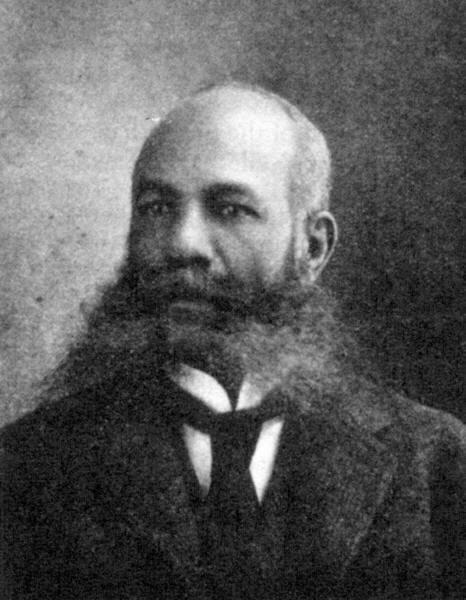

DO YOU KNOW ALEXANDER MILES?

ISSUE 23

ALEXANDER MILES
There is a kind of darkness that comes when the Sun goes down, and there is another kind of darkness that comes when a people no longer remember who they are.
The first darkness can be defeated with a lamp. The second requires KNOWLEDGE.
We Af’rakans have lived too long beneath that second darkness. We have been introduced to ourselves through chains, plantations, colonial maps and the sorrowful pages of the Trans-Atlantic slave trade. We were taught to begin our own story at the point where another people interrupted it. It is like writing the life of a great elder and beginning the biography on the day armed robbers entered his compound. What of the years before the robbery? What of his childhood, his teachers, his discoveries, his family, his wisdom and the house he built before the intruders arrived?
Apparently, according to the lazy version of history, none of that matters. Af’raka was doing absolutely nothing until Europe arrived with a Bible in one hand, a gun in another, a map beneath the armpit and, by some miracle, a third hand ready to collect the gold. We are expected to accept this performance without asking how a people who supposedly had no knowledge built cities, governed kingdoms, worked metals, navigated rivers, studied the heavens, preserved medicines, cultivated difficult lands and carried highly ordered systems of philosophy and spirituality.
No, beloved reader. Our history did not begin in a slave ship.
The slave ship was an interruption, not an origin.
Before the chain was the mind. Before the plantation was the civilization. Before the foreign surname was the ancestral name. Before the category called “slave” was a person—a farmer, a mother, a priest, a fisherman, a builder, a healer, a trader, a metalworker, a ruler, a storyteller, a child, a keeper of seeds, a reader of seasons and, in some cases, an inventor whose knowledge could enrich the very society that denied his humanity.
This is why historical awakening matters. A person who does not know the value of those who came before him will struggle to recognize the value sleeping inside him. If all you have been taught is that your ancestors were helpless, ignorant and waiting to be civilized, you may unconsciously spend your life waiting for another civilization to think on your behalf.
Today, therefore, we will open a door.
It is a fitting door, because the man at the centre of this discourse was an inventor whose name became connected with the safer operation of elevator doors. His name was Alexander Miles. Millions of people have entered elevators influenced by the long development of automatic door systems, yet many have never heard his name. We enjoy the movement, press the button, watch the doors close and continue with our important lives—as if mechanisms grow naturally from the walls when properly watered.
But doors do not design themselves. Patents do not file themselves. A machine does not wake one morning and say, “Today I shall improve public safety.” Somewhere behind every useful mechanism is a human mind that observed a problem, imagined an answer and disciplined that imagination until it entered the material world.
Alexander Miles was one of those minds.
This article is not merely about a patent from 1887. It is about memory, observation, invention, dignity and the spiritual obligation to remember. It is about a Black man who looked at an open danger and did not merely complain about it—he designed a response.
So sit upright, awaken the mind and let us journey together.
1. BEFORE THE CHAIN: THE HISTORY THAT REFUSED TO DIE
The most successful imprisonment is not always the one that locks the body inside a room. It is the one that locks the mind inside a false beginning.
If I convince you that you were nothing before I met you, then everything you become after meeting me can be presented as my gift. If I hide your old books, rename your wisdom, ridicule your spirituality and teach your children that intelligence arrived from abroad, I may no longer need to follow them about with a whip. They will police their own imagination. They will laugh at their grandparents and clap for any stranger who repeats the same ancestral knowledge with a foreign accent and an expensive certificate.
This is one of the deepest forms of mental slavery: not simply the absence of information, but the organized loss of confidence in one’s capacity to know.
The history of Af’raka is far older, wider and more complicated than the history of enslavement. Across the continent were many civilizations, languages, systems of government, schools of thought, methods of agriculture, centres of trade, traditions of healing, artistic sciences, forms of architecture and ways of reading the visible and invisible worlds. Ancient Kemet and Nubia studied number, measure, medicine, time and the heavens. The intellectual traditions connected with Timbuktu preserved works on law, language, mathematics, astronomy, medicine and theology. Across different regions, African workers smelted and shaped iron, built in stone and earth, managed water, bred crops, travelled trade routes and studied Nature with the seriousness of people whose survival depended upon understanding her.
This does not mean every ancient Af’rakan was secretly carrying a university laboratory beneath his wrapper. Let us not replace one foolish history with another. Every civilization contains brilliant minds, ordinary workers, compassionate leaders, greedy leaders, periods of peace, periods of conflict, achievement, error, beauty and contradiction. An awakened person does not need to lie in order to become proud. A borrowed exaggeration is still a chain, even when it has been painted black.
We must also be careful with the popular claim that Af’raka gave the West “90 percent of everything it knows.” Human knowledge does not move in such a simple, tidy percentage. Civilizations learn, trade, steal, preserve, translate, forget, rediscover and improve. African, Asian, Middle Eastern, Mediterranean, European and Indigenous knowledge systems have all met one another across long periods of human history. Knowledge behaves more like a river than a private bucket. It flows through many lands, gathers many streams and is often renamed by whoever builds the latest bridge across it.
What is true—and more than powerful enough—is that Af’raka was never an empty intellectual space. Europe did not meet a continent without thought. Enslavers and colonizers encountered people with land, memory, social order, technical skill and spiritual identity. Those systems were damaged, exploited, dismissed or recast through foreign categories, but they were not imaginary.
This is where our anger must become intelligent.
There are people who say, “Everything was stolen from us,” and then spend the entire day refusing to study what was stolen. They post ten angry messages, insult five strangers, watch six hours of entertainment and go to sleep feeling that they have served the ancestors. My brother, the ancestors are not impressed by your data subscription. If your awakening produces only noise and no discipline, you have simply moved the chain from your neck to your comment section.
History must do more than give us somebody to blame. It must give us something to build.
Here in Nigeria, the concern about historical education is not invented. History disappeared from the basic-school curriculum around 2009/2010 and was later ordered back as an independent subject. By 2025, Nigerian History was again made compulsory across primary and secondary education. That long absence mattered. A generation can learn to calculate profit, identify parts of a computer and recite imported political dates while remaining almost completely unable to locate itself inside its own civilizational story.
Yet we should not turn every failure into a theatrical conspiracy in which hidden men sit underground stroking cats and planning Tuesday’s curriculum. Sometimes neglect, poor policy, shortage of teachers, weak institutions and contempt for the humanities can produce terrible results quite openly. The effect is serious whether the foolishness was designed in a secret room or approved in an air-conditioned office by people who simply did not understand what history does to the soul of a nation.
History is not merely a pile of old dates. It is a mirror handed from one generation to the next.
When that mirror is broken, children grow up seeing only fragments. One fragment says slavery. Another says colonialism. Another says poverty. Another says corruption. If no one joins the pieces, the child may believe that brokenness is his complete face.
But the true student of Light gathers the pieces.
The mystic understands that memory is more than mental storage. Memory is continuity. A name spoken with understanding links the present mind to an earlier labour. When we remember an ancestor, a thinker or an inventor, we do not drag the dead back into the physical world. We rescue a living principle from forgetfulness. We say: this life occurred; this mind worked; this contribution mattered; this possibility also belongs to the human story.
That act changes the person who remembers.
When a young Af’rakan learns only that people who looked like him were bought and sold, he may inherit sorrow. When he also learns that people who looked like him designed, organized, experimented, resisted, patented, healed, wrote, calculated and built, sorrow gains a companion called possibility.
This is why controlling the story of a people can be more powerful than controlling one election. Political control may last for a season. A distorted self-image can reproduce itself for generations.
However, let us also look inward. Foreigners did not force us to abandon every book we refused to read. They did not personally hold our hands while we failed to interview our elders. They are not inside our homes commanding us to laugh at indigenous languages. Nobody from London enters your compound every evening to switch your television from a historical documentary to gossip. At some point, responsibility must return home.
We cannot continue blaming the thief for stealing a treasure while refusing to protect, study or even identify what remains.
The first step out of mental slavery is not hatred. It is disciplined remembrance.
The second is research.
The third is creation.
And the fourth is transmission: teaching the next generation so thoroughly that erasure becomes more difficult.
That brings us to the people carried across the Atlantic—not as a faceless crowd, but as human beings who carried worlds within them.
2. THEY WERE NEVER CARGO: KNOWLEDGE CARRIED IN HUMAN BODIES
The language of slavery was designed to reduce persons into units. A man became a hand. A woman became property. A child became an increase in somebody’s inventory. People with names were entered into records as numbers, ages, prices, colours and physical conditions. This was not only economic violence; it was spiritual violence, because it attempted to separate the human being from the sacred fact of personhood.
Therefore, when I say that those taken away were not common people, I must explain myself properly.
I do not mean that every captive was a royal astronomer, a master engineer or an initiate of a great mystery school. The historical evidence does not support such a claim. Enslaved Africans came from many communities and occupations. They included farmers, herders, fishers, traders, builders, soldiers, metalworkers, craftspeople, healers, parents, children and people whose precise skills were never recorded by those who bought them.
I mean something more fundamental:
No human being is common enough to become cargo.
Every person carried a language, a memory, a relationship, a skill, a fear, a hope and a possible future. Even the person who could not read a manuscript might know when to plant by watching insects, wind and soil. Even the person who had never entered a palace might understand water, wood, birth, iron, food, weather, community or rhythm in ways the enslaver did not. A civilization is not sustained by famous scholars alone. It is also sustained by the countless people who know how to keep life moving.
Some enslavers deliberately valued Africans from particular regions because of what they knew. On the Atlantic coast of what became the United States, Africans from rice-growing regions of West Africa carried detailed knowledge of rice cultivation. Enslaved workers built and maintained complicated systems of dikes, drains, ditches, embankments and floodgates. Their labour was brutally exploited, but that labour was not mindless. It required environmental understanding, timing, engineering judgment and generations of agricultural knowledge.
Think about the irony carefully. The same system that declared a people inferior depended upon their expertise to become rich.
This is one of history’s most shameless jokes, except nobody should be laughing.
Africans and their descendants also worked as blacksmiths, carpenters, masons, mechanics, boatmen, seamstresses, cooks and artisans. Some brought knowledge from Africa; others developed expertise under bondage and passed it through families and communities. Yet the record often preserved the name of the owner, the plantation, the merchant or the company while the maker became “unknown.” The chair survived, but not the carpenter. The rice wealth survived, but not every engineer of the water system. The metal survived, but the blacksmith’s name dissolved into somebody else’s account book.
This is why the archive can appear silent. The silence does not always mean no one spoke. Sometimes it means the keeper of the record did not consider the speaker worth naming.
There is also no need to invent a single, universal story in which every captured African scientist was tortured in exactly the same way until he surrendered a secret formula. Enslavement was already monstrous without our adding scenes for which we have no proof. Families were separated. Women and girls suffered sexual violence. People were beaten, sold, worked to death, stripped of legal rights and forced to create wealth they could not own. Skills were exploited in fields, workshops, kitchens, foundries, docks and homes. These realities are documented. They do not require decoration.
Truth is not weak because it is careful.
In fact, truth becomes dangerous to oppression when it is so exact that nobody can dismiss it as fantasy.
After emancipation, legal freedom did not remove racial barriers. Black inventors worked inside societies that often denied them education, capital, professional positions, fair publicity and commercial opportunity. Some did obtain patents, but many others may have remained absent from the record. In the late nineteenth century, Henry E. Baker, a Black assistant patent examiner, began tracing patents granted to African American inventors. The task was difficult because United States patents did not identify the race of inventors. Some inventors may also have concealed their racial identity, fearing that prejudice would damage the market value of their work.
Imagine that: a person must decide whether the public is ready to buy his invention but not ready to know the colour of the mind that invented it.
Racism is often presented as though it were only an insult shouted across the street. But structural racism can operate quietly through access to education, financing, employment, publication, ownership, legal help and recognition. A man may possess an excellent idea and still lack the money to build a prototype, the lawyer to protect it, the factory to produce it or the network to bring it into the market.
A patent itself is not a bag of money descending from heaven. It is a legal right. It can help protect an invention, but it does not guarantee manufacturing, sales, fame or fortune. There are patent holders who died wealthy, patent holders who struggled and inventors who watched others profit more greatly from their ideas. The Universal Law may place potential within the mind, but the material world still requires discipline, resources, timing, relationships and wise action.
This is an important lesson for the modern Af’rakan youth. We often celebrate the final object while ignoring the entire system around invention. We want the finished car, but not the laboratory. We want the successful app, but not the long nights of testing. We want to announce that an ancestor created something, but we do not want to read the patent. We want the title “inventor” because it sounds spiritually expensive, yet the smallest technical question sends us running like a goat that has seen its reflection in a mirror.
Knowledge demands patience.
If we wish to honour Black inventors, we must do more than place their photographs on social media once a year. We must understand the problems they solved. We must learn the science behind their work. We must build schools that allow children to touch materials, dismantle machines, write code, study patents, cultivate land, make instruments and test ideas without being insulted for asking too many questions.
The child who opens the radio to discover where the voice is hiding should not immediately be beaten as a destroyer of property. Perhaps buy him one dead radio and say, “Find out.” The young girl who keeps asking why should not be silenced because the adult is tired. “Why” is one of the sacred doors of intelligence.
This is how civilizations awaken: curiosity is not punished; it is trained.
Our ancestors carried knowledge in human bodies because, in many traditions, the living person was the first library. Techniques were sung, demonstrated, repeated, initiated and transmitted. When that person was stolen, a shelf was torn from the community. When a language was forbidden, an index was damaged. When a child was separated from an elder, a school was interrupted.
Yet the knowledge did not disappear completely. It adapted. It entered food, music, craft, agriculture, spiritual practice, family customs, resistance, language and invention. The enslaved body was controlled, but consciousness continued searching for a passage.
This brings us to a powerful principle of mysticism: the creative mind seeks manifestation.
An idea begins in an invisible state. It may arrive as a question, an image, an uneasiness or a sudden recognition that something can be done better. The idea is not yet a machine. It has no metal, no belt, no hinge and no legal protection. It exists first within consciousness.
Then the mind gives it form.
The inventor observes natural law, tests possibilities, corrects failure and gradually brings the invisible pattern into visible matter. This is mental alchemy. Not the childish fantasy of waving a wand and producing gold, but the disciplined transformation of thought into useful reality.
Every invention passes through this inner gate.
Alexander Miles passed through it.
He did not begin as the director of a famous engineering institution. He was known first as a barber, entrepreneur and property owner. That fact alone should awaken somebody. Genius does not always wear the uniform we expect. Wisdom may be holding a razor. Observation may be sweeping hair from a floor. The future invention may be forming quietly inside a person whom society has placed in the wrong category.
If you judge every mind by its current occupation, you may greet a great inventor and ask only whether he can trim your beard.
Let us meet the man more carefully.
3. ALEXANDER MILES: THE BARBER WHO SAW AN OPEN DANGER
Alexander Miles was born on May 18, 1838, near Circleville, Ohio, in the United States. He came into a nation deeply shaped by slavery and racial hierarchy, even though Ohio was legally a free state. To be born outside legal bondage was not the same as being born into equality. The colour line still attempted to decide where a Black person could live, learn, work, invest and belong.
Miles nevertheless developed a life of movement, enterprise and observation.
He worked as a barber in Wisconsin and experimented with hair-care products. This detail may look small to a person waiting for history to announce greatness with thunder, trumpets and twelve white horses. But the awakened reader should pay attention. A barber in the nineteenth century did more than cut hair. The barbershop could be a centre of conversation, information and community. It also required the practical intelligence of service: understanding people, tools, cleanliness, presentation, trust and business.
The hand that works with a razor must learn precision. The eye that studies the face learns detail. The mind that runs a shop learns that a good idea is useless if it does not serve a real need.
Miles eventually moved to Minnesota and, by 1879, was operating a barbershop in Duluth’s St. Louis Hotel. Historical accounts identify his wife as Candace and their daughter as Grace. In Duluth, he did not remain within the narrow economic box society prepared for him. He used his earnings to enter real estate, became the first Black member of the Duluth Chamber of Commerce and developed a three-storey commercial building known as the Miles Block.
Pause here.
This was a Black man in the nineteenth century, working inside a society soaked in racial prejudice, moving from barbering into business, property and civic life. He did not wait for the world to become fair before developing himself. He could not control every barrier, but he worked with the openings available to him and widened them.
That does not mean we should turn his story into the usual motivational sugar: “If Alexander Miles succeeded, everybody can succeed, so oppression does not exist.” Nonsense. One person overcoming a wall does not prove the wall was imaginary. It proves that the person possessed unusual persistence—and perhaps that some openings existed which many others were denied.
We honour achievement more honestly when we also name the resistance around it.
Miles became concerned with elevator safety. At the time, elevator systems did not all operate with the smooth automatic doors familiar to us today. Cabin doors and shaft openings could require manual operation. If a shaft door was left open while the elevator car was elsewhere, the opening became a deadly trap. People did fall into elevator shafts.
One often repeated story says Miles was riding with his young daughter when he noticed a shaft door left dangerously open. Another account suggests the elevators near his hotel workplace regularly drew his attention. We cannot establish with certainty which moment created the invention. History sometimes remembers a useful life but loses the exact instant when an idea entered it.
What we do know is written in the patent itself.
On May 23, 1887, Alexander Miles filed an application for an elevator improvement. On October 11 of that year, the United States issued him Patent No. 371,207.
The patent concerned mechanisms for automatically operating elevator-car doors and closing openings to the elevator shaft. Miles described the danger created when a person neglected to close the shaft opening. His design used a system involving belts, drums, levers, rollers and specially shaped tracks or grooves. As the elevator car arrived at or left a floor, the movement of the mechanism would help open and close the appropriate doors.
In simple language, Miles wanted the elevator to participate in its own safety.
Instead of depending entirely upon every human passenger or operator to remember every door every time, he designed a mechanical arrangement that connected the movement of the car with the operation of the doors. He took a repeated human failure—forgetfulness—and answered it with design.
This is more profound than it first appears.
A weak thinker sees the careless person and says, “People are foolish.”
A useful thinker asks, “Can the system be designed so that one moment of carelessness is less likely to become a funeral?”
This is the difference between complaint and invention.
Now, we must be accurate. Alexander Miles did not invent the first elevator, and he did not originate every possible automatic elevator-door mechanism. John W. Meaker received an earlier United States patent in 1874 for a self-closing hatchway arrangement, and other inventors were also working on elevator safety. Miles’ importance lies in his own patented improvement within that developing history.
Why make this distinction?
Because giving a Black inventor false credit does not honour him. It makes his true credit easier to attack.
Some people believe that pride must be fed with exaggeration. I disagree. Alexander Miles does not become smaller because another inventor came before him. The Sun does not become ashamed because the Moon also gives light at night. Knowledge advances through many minds. One person sees a problem, another proposes a mechanism, another improves it, another makes it cheaper, another adapts it to electricity and another develops the sensors used generations later.
Civilization is a long conversation.
Miles deserves his proper voice in that conversation.
His patent was not a modern electronic door with infrared sensors, microprocessors and all the silent intelligence of a present-day lift. It belonged to the mechanical world of belts, drums, levers and physical contact. Yet the principle he addressed remains central: the car door and the landing or shaft door must operate in a coordinated way so that passengers are protected from the open shaft.
The exact machinery has evolved. The human need has not.
Whenever you enter a modern elevator and the landing doors remain safely closed until the car is properly positioned, you are experiencing the mature form of a problem that inventors such as Miles helped address. It would be inaccurate to say every modern system is a direct copy of his patent. It is fair to say his work belongs to the history that made automatic elevator safety a normal expectation.
That is the strange fate of successful invention: once a safety feature becomes ordinary, people forget that danger came first.
Nobody enters a lift today and cries, “Glory be! The shaft did not remain open!” We complain that the elevator took nine seconds. Human beings quickly convert miracles of engineering into opportunities for impatience.
Miles saw what others passed every day.
This ability to see is at the heart of invention and also at the heart of mysticism.
The mystic is not merely a person who closes his eyes, burns incense and speaks as though every sentence must walk through fog. The true mystic observes principles. He studies cause and effect. He asks what visible event reveals an invisible law. He notices relationships hidden beneath ordinary experience.
An elevator is moved by forces. Weight, tension, motion, balance, friction, timing and resistance must cooperate. The machine does not respond to wishful thinking. If the mechanism is wrongly designed, prayer will not persuade the belt to become the correct length. Nature is spiritual, but Nature is also exact.
This is why true mysticism does not oppose science. The mystic and the scientist may use different language and methods in some areas, but both can stand in reverence before law. The awakened inventor understands that he does not command Nature like a frightened servant. He studies her conditions and works in harmony with them.
Miles did not create the law of motion. He arranged matter so that motion could perform a useful duty.
This is the human role in creation. We do not create the ultimate laws, but we can discover relationships within them. The tree contains wood; the Earth contains metal; the mind contains image; experience presents a need. Through labour, these elements meet and a mechanism appears.
The invisible becomes visible.
Thought enters form.
That is one meaning of invention.
Alexander Miles’ story also reminds us that great observation often begins close to home. He did not need to travel to another galaxy to find a problem. The danger was beside an elevator. He did not wait for a committee of international experts to discover it. He paid attention.
Many Af’rakan youths are praying for a billion-dollar idea while stepping over ten local problems on the way to the prayer meeting. The gutter is blocked. The farm loses produce. The clinic lacks a simple device. The local language has no useful learning app. The artisan cannot reach customers. The power supply fails. The water is wasted. Yet everybody is asking the heavens to reveal “the next big thing,” preferably something that already succeeded in California.
Beloved, perhaps your revelation is hiding inside the inconvenience you complain about every morning.
The problem is knocking, but you are waiting for prophecy.
Miles teaches us to look again.
4. THE DOOR HE OPENED: INVENTION, MEMORY AND THE LAW OF ASCENT
An elevator is one of the most useful symbols for the journey of a people.
It rises, but it also descends. It moves between levels. It requires power, balance, guidance, boundaries and a secure door. Its success is not measured only by how high it can go, but by whether it carries life safely from one level to another.
Progress is the same.
A nation may build tall towers and still descend morally. A person may rise financially and collapse spiritually. A community may gain political power yet leave the doors of corruption wide open. Height alone is not ascension.
True ascent is elevation with consciousness.
This is where Alexander Miles becomes more than a name in a list of inventors. His work offers us a spiritual metaphor with iron inside it.
The open elevator shaft represents unguarded danger. In our collective life, ignorance is such a shaft. Distorted history is such a shaft. Racial self-hatred is such a shaft. A young person walking confidently through a world whose hidden gaps he does not understand may fall, not because he lacks intelligence, but because nobody closed the dangerous opening or taught him to recognize it.
Education should be a door of protection.
History should open when the car of consciousness has arrived—and remain closed against the emptiness of propaganda.
Discernment is also a door. The awakened mind does not remain open to every claim simply because it sounds proud, spiritual or revolutionary. Not every viral story is ancestral knowledge. Not every man wearing beads is an initiate. Not every foreign scholar is an enemy. Not every Black speaker is correct. Not every statement that makes us feel powerful is true.
A mind without discernment is an open shaft.
Someone will eventually fall into it.
This is why the proper recovery of Alexander Miles matters. We should not merely replace the old silence with a heroic legend polished beyond recognition. We must study the man, the document, the period and the mechanism. The patent is publicly available. Read it. Look at the drawings. See how nineteenth-century invention was described. Ask what the device did and what it did not do.
A patent is not an ancestral drum. It will not announce itself merely because we are angry. Someone must search for it.
The spiritual principle here is responsibility. Once knowledge comes to you, you become responsible for what you do with it. You can use the name of Alexander Miles to win an argument online, or you can let his example rearrange your conduct.
What did he do with observation?
He converted it into design.
What did he do with a service trade?
He converted it into capital and enterprise.
What did he do with social limitation?
He did not pretend it was absent, but he also did not allow it to define the entire boundary of his thought.
His life in Duluth extended beyond the elevator patent. He developed property and participated in business life. Later, after relocating to Chicago in 1899, he helped establish The United Brotherhood, an insurance enterprise intended to serve Black people who faced discrimination from white-owned insurance companies. He later lived in Seattle and eventually returned to barbering.
That insurance effort reveals another kind of invention: institutional invention.
When a community is excluded from an existing structure, it can spend eternity begging at the gate—or it can organize a structure capable of serving its own needs. The second path is not simple. It requires capital, trust, administration, accountability and patience. But political speeches cannot replace institutions.
Af’raka does not suffer only from a shortage of ideas. We suffer from the collapse of continuity around ideas. One brilliant person begins a project; no system is built around it. When the person becomes tired, travels or dies, the project becomes a framed photograph and a long speech at an anniversary dinner.
The true mystical principle of manifestation requires structure. Spirit without form remains intention. Vision without organization becomes beautiful frustration.
This is why our awakening must enter schools, workshops, archives, laboratories, farms, businesses, publishing houses and legal systems. We cannot meditate our way out of every material responsibility. Meditation can clarify the mind that must perform the work. It does not replace the work.
If a bridge is required, wisdom must become measurement, material and construction. If a patent is required, inspiration must become drawings, claims and an application. If a historical record is missing, love for the ancestors must become interviews, preservation, research and publication.
Otherwise, we will possess the Light emotionally while darkness continues administratively.
Alexander Miles was inducted into the National Inventors Hall of Fame in 2007—eighty-nine years after his death in 1918. The recognition was deserved, but it arrived long after the inventor could stand beneath it.
Some may say, “At last, the West decided to honour him.” But let us be careful again. The National Inventors Hall of Fame’s recognition is valuable; it is not the final court of ancestral existence. Alexander Miles did not become important in 2007. Recognition did not create his contribution. It acknowledged what had already occurred.
If we wait for every foreign institution to certify our heroes before we study them, then we are still asking another person for permission to remember.
At the same time, historical maturity requires us to accept uncertainty. Popular accounts sometimes describe Miles as one of the wealthiest Black men in his region. Other evidence suggests that his later financial life was difficult. It is also unclear how much money he earned from the elevator patent or whether he successfully sold its rights. A Hall of Fame title can make a life appear smooth after the fact, but real lives contain reversals.
This does not reduce him.
In fact, it makes the story more human. A person can create something useful without becoming permanently wealthy. Market reward and spiritual value are not identical. History is full of people whose labour enriched the future more than it enriched their own pockets.
We should stop measuring every inventor by whether he died surrounded by gold furniture. Wealth is important, ownership is important and creators deserve compensation. But usefulness is also a form of legacy. The idea that only a billionaire has succeeded is one of the strangest religions of the modern world. Its temples are luxury pages, its hymns are motivational slogans and its prophets are often renting the car used for the photograph.
Miles’ life invites a deeper question: What does your consciousness do when it meets danger?
Does it complain?
Does it blame?
Does it walk away?
Or does it study the mechanism and create a safer passage?
This is the law of awakened service. The Light within is not given merely to decorate the personality. It is given so that one can illuminate a path. A Light Worker who solves no problem, heals no ignorance, builds no structure and serves no life must examine whether the Light has entered action or remained a title in a biography.
The inventor is a servant of possibility.
He stands between what is and what may be. He sees the present machine, but also the improved machine hidden inside it. He listens to the complaint of reality without becoming imprisoned by the complaint. He understands that every problem contains information about the shape of a possible answer.
This is close to what the ancient Af’rakan mind understood about Nature. Nature was not simply dead material waiting to be conquered. It was law, rhythm, relationship and living order. The seasons taught timing. The river taught movement. The seed taught hidden potential. Iron taught transformation through heat. The heavens taught cycles. The body taught balance. Knowledge arose from attention.
The modern inventor and the ancient observer meet at the same gate: both must learn to see.
However, seeing is not enough. The imagination must submit to testing. A vision that refuses examination can become delusion. A spiritual student who says, “The ancestors gave me this machine in a dream,” must still discover whether the machine works when metal, gravity and human safety enter the room. Universal Law will not suspend itself to protect our ego.
The cosmos is generous, but it is not careless.
Alexander Miles’ patent drawings represent this union of imagination and discipline. The idea entered lines, parts, relationships and legal claims. The inner picture accepted the burden of form.
That is what Af’raka must do now.
We have spoken enough about greatness in the past to begin creating evidence in the present. The fact that our ancestors were knowledgeable should not become a mattress upon which we sleep. It should become a bell that wakes us.
What good is it to say Kemet studied the stars if our children cannot study mathematics without fear?
What good is it to praise ancient metalworkers if modern artisans remain without tools, credit and protection?
What good is it to shout that our knowledge was stolen if we do not document the knowledge still living in villages, workshops and families?
What good is it to celebrate Alexander Miles if a brilliant young inventor today has no mentor, no prototype fund, no patent guidance and no safe laboratory?
Ancestral pride without present responsibility is spiritual entertainment.
We must build the elevator, not merely admire the old floor.
THE INNER MEANING OF THE MILES LEGACY
There are several lessons hidden inside this one life.
The first is the Law of Observation: what you repeatedly ignore may contain the assignment you repeatedly request. Miles encountered an everyday danger and gave it sustained attention. Many discoveries are hidden inside common things because common things are where human beings actually live.
The second is the Law of Mental Causation: every made object existed as a pattern in consciousness before it took physical form. The idea alone was not enough, but the material form could not arrive without it. Thought is a seed; work is cultivation; form is harvest.
The third is the Law of Service: the strongest inventions answer a human need. A device that protects life carries a different spiritual weight from a device created merely to exploit weakness. Intelligence is power, but conscience must decide how power is used.
The fourth is the Law of Continuity: no inventor stands alone. Miles entered an existing history of elevator design and added his own improvement. Others continued after him. The childish ego asks, “Who did absolutely everything first?” Wisdom asks, “What did this person truly contribute, and how did that contribution help the whole?”
The fifth is the Law of Recognition: value can exist before applause. A person may be forgotten by the crowd and still have mattered. The noise of the present is not the final measure of a life.
The sixth is the Law of Memory: what a people repeatedly remember shapes what they repeatedly attempt. If we remember only defeat, caution grows. If we remember truthfully—defeat, resistance, skill, error, survival and achievement—our range of possible action expands.
The seventh is the Law of the Door: every level requires a proper opening and a proper closing. Some doors must open to knowledge. Some must close against falsehood. Some must open to cooperation. Some must close against exploitation. A door that never opens is a prison; a door that never closes is a danger. Wisdom is knowing which movement the moment requires.
This is the balance Miles’ invention symbolizes.
The elevator itself does not insult the lower floor. The lower floor is a point of departure. There is no shame in beginning below. The tragedy is refusing to enter, refusing to learn the mechanism or entering without closing the door of distraction behind you.
Af’raka is not condemned to remain where history pushed her. But ascent will not come from affirmation alone. An elevator may contain the words GOING UP in large golden letters, but without power and mechanism it remains a decorated room.
Likewise, a continent can shout AF’RAKA MUST RISE at every conference and still remain on the ground floor if its institutions do not move.
The power is education.
The cables are discipline and continuity.
The control system is wise leadership.
The doors are discernment and protection.
The passengers are the people.
The destination is not supremacy over another race. It is mastery over ignorance, poverty of thought, self-hatred, corruption and dependence.
We do not need to become what wounded us. Historical awakening should not transform Black people into another group drunk on racial superiority. If your discovery that one race lied to you now gives you permission to lie about another race, you have not awakened; you have merely changed sides in the same nightmare.
The purpose of restoring Alexander Miles is not to prove that Black people are the only intelligent people. It is to destroy the lie that Black intelligence was absent.
There is a difference.
Truth restores balance. Supremacy destroys it.
We must therefore teach these histories with accuracy, confidence and depth. We should place inventors such as Miles beside other Black innovators, but also inside the wider history of technology. Let students compare patents. Let them see the earlier and later mechanisms. Let them ask what changed. Let them build models. Let them identify unsolved problems in their own communities.
That is how history becomes alive.
The goal is not for a child merely to memorize: “Alexander Miles, elevator doors, 1887.” That is three facts wearing a school uniform. The goal is for the child to understand:
- A Black inventor observed a public danger.
- He designed a mechanical response.
- He protected the idea through a patent.
- He also built businesses in a hostile social environment.
- His work formed one part of a longer technological development.
- His name was not always given the public attention it deserved.
- The child, too, can learn to observe, design, protect and serve.
Then the lesson has entered consciousness.
AWAKEN THE INVENTOR WITHIN
Beloved reader, now you know Alexander Miles.
But knowledge of a name is only the first floor.
The next question is whether his life changes the way you look at your own surroundings. What danger have people accepted because “that is how it has always been”? What daily inconvenience is waiting for a patient mind? What local knowledge is dying because nobody has documented it? What gifted child is being called stubborn because he dismantles objects to understand them? What young woman has been told invention is not for her? What craftsperson has a brilliant improvement but no idea how to protect it?
Do not merely search for heroes. Create conditions in which new heroes do not have to fight every battle alone.
Parents, give curiosity room.
Teachers, teach history as a living field, not a cemetery of dates.
Researchers, separate evidence from emotional wish.
Inventors, document your work.
Entrepreneurs, learn ownership and intellectual property.
Governments, fund laboratories, archives, workshops, museums and technical education—not only speeches beneath decorated canopies.
Spiritual students, understand that manifestation requires form.
And to our youths: your phone can do more than carry gossip at the speed of Light. It can open patent databases, digital archives, lectures, engineering courses and historical records. If a machine gives you access to half the world’s published knowledge and you use it only to investigate who unfollowed whom, the colonial master is no longer your greatest problem.
At some point, one must accept the terrible news that discipline is also part of liberation.
Alexander Miles reminds us that greatness does not always arrive from the place society expects. A barber may become an inventor. A shop may become a school of observation. A dangerous door may become the beginning of a patent. A forgotten name may become a lamp for another generation.
This is why the recovery of history is sacred.
To remember rightly is to repair a broken bridge between the dead, the living and the unborn. The ancestors do not need us to manufacture impossible stories for them. They need us to tell the truth, preserve the evidence and continue the work.
Our people crossed oceans in chains, but their consciousness was not empty. Their descendants entered professions, built communities, developed businesses, created art, advanced science and filed patents in societies that often doubted their humanity. Alexander Miles was one of them—a man who looked at a dangerous opening and imagined a mechanism by which it could be closed.
May we do the same with the openings in our own civilization.
May we close the door against ignorance.
May we open the door to accurate history.
May we close the door against racial hatred.
May we open the door to disciplined self-knowledge.
May we close the door against the habit of waiting for rescue.
May we open the door to invention, service and collective ascent.
Af’raka, the elevator of consciousness has arrived.
The doors are open.
Will you enter—or will you remain outside arguing about who pressed the button?
Awake, remember and create.
MAN, KNOW THYSELF.
LOVE AND LIGHT.
Written by Knight Fredel © 2019–2026
RESEARCH AND FURTHER READING
This expanded edition distinguishes documented history from popular retellings. Readers who wish to go deeper may consult:
- Alexander Miles, U.S. Patent No. 371,207, “Elevator” (1887) — the primary patent text and drawings.
- Alexander Miles — National Inventors Hall of Fame — biographical overview and 2007 induction.
- Alexander Miles — Duluth Public Library, Vintage Duluth — local history concerning Miles, the Miles Block and his work in Duluth.
- John W. Meaker, U.S. Patent No. 147,853 (1874) — an earlier related self-closing hatchway patent, useful for understanding the longer development of elevator safety.
- “Found on Baker’s List” — United States Patent and Trademark Office — Henry E. Baker’s work identifying early African American patent holders and the barriers surrounding their recognition.
- Rice Fields in the Lowcountry — Smithsonian National Museum of African American History and Culture — the specialized agricultural and hydraulic knowledge of enslaved Africans and African Americans.
- Gullah Geechee Culture — U.S. National Park Service — West and Central African cultural survival and rice-growing expertise.
- History Now Mandatory at Basic-School Level — Radio Nigeria — Nigeria’s removal and later reintroduction of History in the basic-school curriculum.
- Nigerian History Made Compulsory in Schools — The Guardian Nigeria — the 2025 curriculum decision.