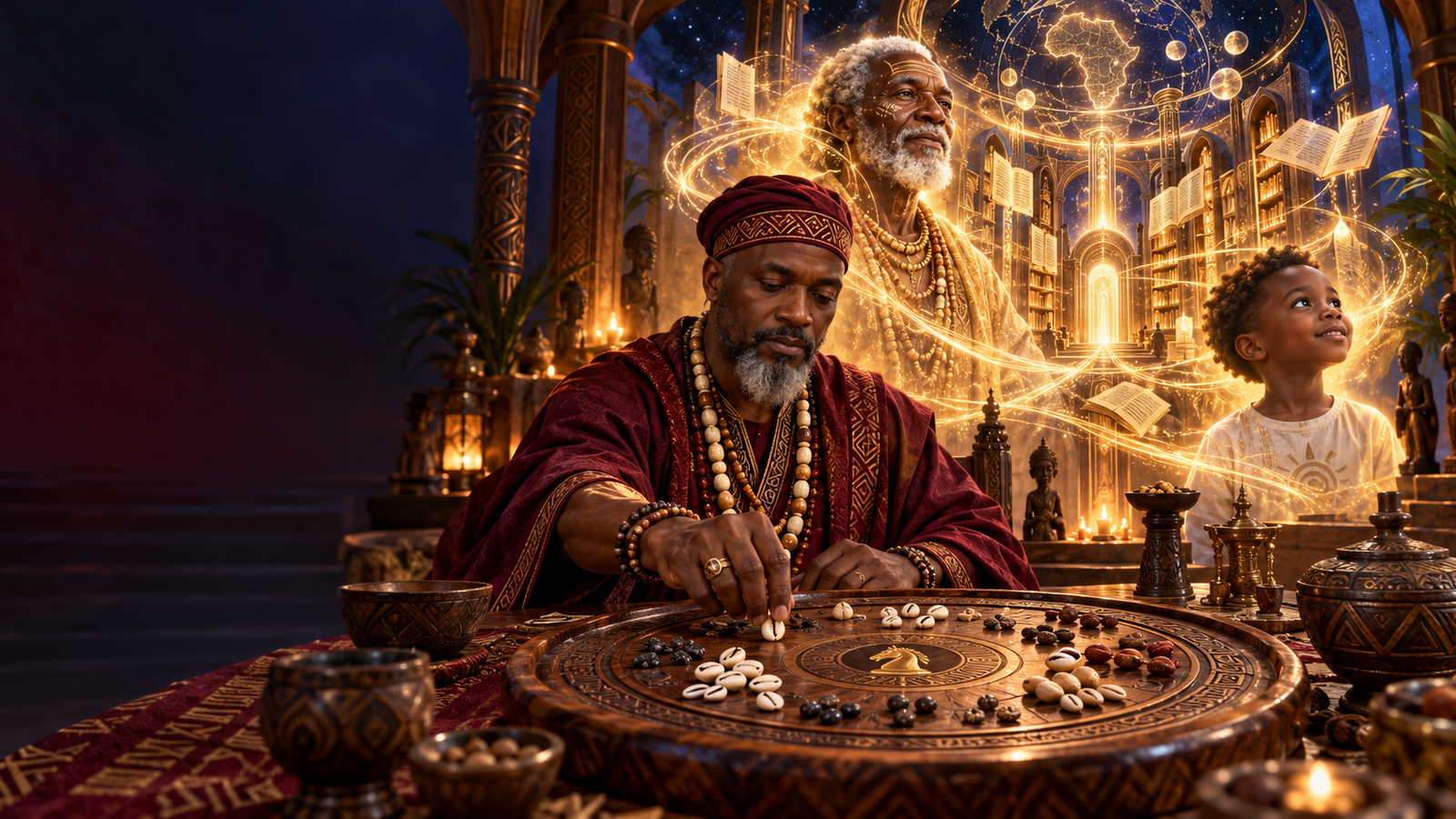

ORACLE AND ANCESTORS: Who Speaks When the Ancestors Have Returned?
Traditional priests say the ancestors speak through the oracle. But if the soul reincarnates, are those ancestors not already living again? Knight Fredel resolves the paradox by separating the reincarnating soul from the enduring mind-record—and revealing the oracle as an instrument that searches the ancestral memory of the Akashic field.

ISSUE 27
By Knight Fredel
Awake Afraka Magazine — Expanded Magazine Edition
First published © 2019, June 23. Expanded edition © 2026.
Knowledge is the light of this century, and enlightenment must take place before humanity can ascend beyond its present level of consciousness. When we were children, we did not understand the workings behind many spiritual phenomena. Today, much has been brought into the light, and that light I am prepared to shine upon your path.
Editorial clarity: This article presents Knight Fredel’s metaphysical teaching on reincarnation, ancestral consciousness, oracles and the Akashic Records. These are spiritual propositions. Historical and academic references are supplied as illumination and mystical mechanism.
PROLOGUE:
THE VOICE BEHIND THE ORACLE

Across Afraka, there are priests, diviners, shamans and spiritual practitioners who consult voices they identify as ancestors. A seeker brings a question. The priest prepares the oracle, invokes the appropriate forces, casts the instrument or enters the necessary state of communion. An answer arrives.
Sometimes the answer exposes a hidden family matter. Sometimes it warns of danger, interprets a recurring pattern, identifies an unresolved conflict or offers a solution the seeker had not considered. At other times, the oracle appears to describe an event before it occurs.
The usual explanation is simple: the ancestors have spoken.
But that answer creates a deeper question.
If reincarnation is real, if souls return repeatedly through new bodies, and if many of the people we call ancestors are already alive again somewhere on Earth, then precisely who is speaking through the oracle?
Is a great-grandfather expected to occupy a new body and remain simultaneously seated in the spirit world, waiting for the family priest to call? Does reincarnation somehow place one soul in two locations? Are the dead operating a celestial customer-care department while also attending nursery school under new names?
Something in that explanation requires examination.
Traditional language often gathers several different spiritual realities beneath the single word ancestor. A biological forebear, a departed personality, a lineage spirit, an inherited memory, a reincarnated soul and an ancestral archetype may all be called by the same name. Once these categories are mixed together, reverence becomes confusion and confusion acquires a drum, a title and several generations of repetition.
This discourse will separate them.
I will explain why the voice reached through an oracle does not always have to be the complete, individual soul of a dead relative. I will show how the soul may reincarnate while the accumulated mental record of a former life remains accessible. I will examine the Akashic field as a universal memory system, the local records held around families and communities, and the spiritual medium through which an oracle retrieves relevant information.
Most importantly, I will explain the statement at the centre of this teaching:
We are our ancestors returne, not copies of them, but continuations of consciousness travelling towards perfection.
The oracle does not destroy that principle. Properly understood, it helps to reveal how reincarnation and ancestral memory can coexist.
Let us enter carefully. The subject is deep, and the mind that rushes into a mystery usually returns carrying only its own assumptions.
PART ONE — THE ANCESTRAL PARADOX
What Do We Mean by “Ancestor”?
An ancestor is first a person from whom one descends. That is the ordinary biological meaning. Your parents, grandparents and the generations behind them form the human chain through which your body, lineage and inherited history arrived.
Spiritual traditions use the word more widely. Ancestor may refer to:
- A biological forebear whose bloodline contributed to the present family.
- A departed personality remembered by descendants after death.
- A reincarnated soul now living through a different body and identity.
- A mental or energetic imprint containing the experience of a completed life.
- A lineage intelligence formed by the accumulated memory of many generations.
- A cultural ancestor whose knowledge shaped a people even without a direct blood relationship.
- An archetypal ancestral force representing an office, principle or collective pattern rather than one individual.
These are related, but they are not identical.
When a diviner says, “Your ancestor is speaking,” the communication may involve one or more of these levels. The priest may be reading a preserved mental imprint. The oracle may be drawing from the accumulated record of the lineage. A familiar ancestral identity may be used as a symbolic face through which information becomes understandable. In some cases, a disincarnate aspect may indeed remain accessible for a period before another incarnation. In other cases, the source may not be ancestral at all, despite wearing the name rather confidently.
That last possibility is why discernment matters. The invisible realm does not issue identity cards at the border.
Reincarnation Changes the Question
According to the mystical principle of reincarnation, the soul does not begin with the body or end with it. A body is a temporary instrument through which consciousness enters matter, gathers experience, faces consequence and continues its evolution.
Death closes one embodiment. It does not necessarily terminate the journey.
The soul may withdraw from the body, pass through stages of rest, assessment and assimilation, and eventually return through another birth. The new life comes with a new body, new brain, new family arrangement, new opportunities and a veil over much of the former personality. The same deeper traveller continues, but the costume, language and daily identity change.
The person who once lived as an elder may therefore return as a child. A woman may return through a male body; a man may return through a female body. A soul may be born within the same lineage, within another people or under conditions very different from the previous life. Reincarnation is not a village tenancy agreement that forbids relocation.
This means many individuals whom families honour as ancestors may already have returned to physical existence.
The University of Virginia’s Division of Perceptual Studies has investigated thousands of reports involving children who appear to remember details of previous lives. Its work does not settle the entire metaphysical question, and researchers use careful terms such as reported or purported memories. Yet the existence of a sustained research programme is important: reincarnation is not merely an idea whispered beside an altar and forbidden from entering serious inquiry.[1]
Mystical traditions arrived at the question long before modern institutions found a grant application for it.
We Are Our Ancestors
Look at the children entering this century. Some display astonishing intelligence, unusual sensitivity, early moral awareness, technological fluency and a refusal to accept explanations merely because an adult delivered them with authority.
This does not mean every child is automatically enlightened. Some have discovered the tablet before table manners. Humanity remains committed to balance. But there is an observable generational acceleration: information that once required years to locate is now available within seconds, while children encounter ideas, cultures and contradictions at an earlier age.
Within my spiritual interpretation, the awakening is not produced by technology alone. Technology is an instrument meeting souls whose accumulated experience has prepared them to use it. Many of the individuals arriving now are old consciousnesses returning under new conditions.
They are not empty containers created for the first time. They are travellers continuing unfinished work.
This helps explain why some children appear inwardly older than their years, why others feel alienated from rigid religion, and why many instinctively challenge doctrines their parents accepted without question. The soul may have already passed through lifetimes of submission, conflict, devotion, disappointment and inquiry. It returns carrying tendencies even when the conscious brain cannot produce the former biography.
The sudden decline of unquestioning religious obedience among many young people may therefore be read as more than rebellion. It can be interpreted as accumulated consciousness refusing to repeat an exhausted lesson.
Religion says, “Believe because we said so.”
The returning soul says, “I have heard this before. Explain it properly.”
Reincarnation Is Continuity, Not Photocopying
To say that we are our ancestors does not mean a child is an exact duplicate of one deceased relative. Reincarnation is not a photocopying office with questionable ink.
Each life adds new circumstances to continuing consciousness. The former personality contributes impressions, abilities, fears, affinities, unfinished duties and karmic tendencies, but the new incarnation develops its own identity. Genetics, upbringing, culture, education, relationships and free will all participate.
The soul is continuous; the personality is reconstructed.
Imagine an actor performing different roles across a long career. Each character has a distinct name, costume, history and emotional world. The role ends, but the actor retains what was learned. The next character is not the previous character, yet the performer carries forward increased skill.
In the same manner, the soul wears personality without being limited to it.
This distinction resolves part of the ancestral paradox. The former personality may leave a record even after the deeper consciousness continues into another form. The complete traveller moves; the account of a completed journey remains.
Why the Former Personality Is Not the Whole Soul
During life, most people identify themselves with name, body, profession, family position, habits and memory. They say, “I am this person.” From the earthly perspective, that identity is real and necessary.
But the soul has occupied more than one personality. No single lifetime exhausts it.
If the soul has lived repeatedly, then the present name is one chapter, not the entire book. The ancestral personality remembered by a family is likewise one chapter. When that soul reincarnates, it does not have to drag every former personality into the new consciousness like luggage on a badly managed bus.
What remains accessible is the record—the energetic architecture of experience created during that life.
The distinction may be expressed simply:
- The body is the temporary physical instrument.
- The personality is the identity developed for one incarnation.
- The mind-record stores the thoughts, experiences and learned patterns of that incarnation.
- The soul is the deeper evolving consciousness travelling through many incarnations.
- The spirit is the highest divine principle through which the soul is connected to Source.
Different schools use these words differently, but the functional distinction is essential. Without it, people imagine that honouring an ancestor requires the full soul to remain permanently trapped beside the family shrine.
It does not.
Honour Is Not Worship
Our ancestors deserve honour. They carried the lineage through famine, war, migration, colonisation, illness and conditions many descendants would find unbearable after six minutes without electricity.
Their courage matters. Their knowledge matters. Their sacrifices matter.
But honour should not become blind worship.
Ancestors were human beings at particular stages of consciousness. Some were wise; some were cruel. Some healed; some wounded. Some protected the family; others created the very trauma their descendants are still attempting to understand. Age does not transform every mistake into sacred law.
If an ancestor practised injustice, repeating it is not loyalty. It is inherited stagnation.
We honour worthy ancestors by preserving their wisdom and correcting their limitations. We honour the lineage by carrying it further than they could. The ancestor who struggled to educate one child is honoured when descendants educate many. The ancestor who survived oppression is honoured when descendants stop oppressing one another.
Worship freezes the ancestor into perfection. Honour recognises contribution while allowing evolution.
The journey continues because perfection was not completed in one lifetime—not for them and certainly not for us, despite what some social-media biographies suggest.
PART TWO — WHAT SURVIVES THE BODY?
The Body Returns to Matter
The physical body is made from the substance of Earth. It is assembled, nourished, repaired and eventually dissolved through material processes. After transition, it returns to the elements from which it came.
The body carries the nervous system and brain through which earthly personality operates. Damage the brain and memory, speech, emotion or behaviour may change. This demonstrates the importance of the physical instrument, but it does not automatically prove that consciousness begins and ends inside it.
A damaged radio can distort a broadcast without having created the station.
The materialist interprets consciousness as a product of brain activity. The mystic interprets the brain as an interface through which a larger consciousness is translated into physical experience. The argument remains open in public inquiry. Within this discourse, we proceed through the mystical model.
At death, the body can no longer sustain the incarnated personality. The soul withdraws. Yet experience is not simply thrown into nothingness.
The Mind as an Energetic Record
The mind is more than the conscious stream of thought you notice while awake. It includes memory, association, imagination, habit, emotional pattern, belief, learned skill and the meanings attached to experience.
Within the metaphysical framework presented here, mental activity leaves impressions in a subtle field. Thought does not remain permanently imprisoned in the brain; it creates patterns that can outlast the body through which they were expressed.
This enduring pattern is what I call the mind-record or mental imprint of the incarnation.
It contains:
- Experiences gathered during the lifetime.
- Decisions and their consequences.
- Skills, solutions and discoveries.
- Emotional patterns and unresolved conflicts.
- Relationships and lineage connections.
- Ritual, medicinal and environmental knowledge.
- The person’s characteristic mode of thought.
- The energetic signature through which that record may be recognised.
The soul assimilates the essence of experience and continues. The record remains available within the larger field of memory.
That record may answer when approached through a compatible oracle—not because the former soul is necessarily sitting idle in the ancestral realm, but because the informational structure of that life remains accessible.
The Akashic Record: The Memory of Experience
Mystical schools use the expression Akashic Records for a non-physical field believed to contain impressions of events, thoughts, actions, emotions and intentions. The word akasha comes from Sanskrit language associated with space or ether; the modern “record” formulation became prominent through Western esoteric and Theosophical teaching.[2]
The name may be relatively modern, but the intuition behind it is ancient: nothing experienced is entirely lost.
Different traditions describe a book of life, cosmic memory, universal mind, astral light, ancestral field or spiritual archive. The language varies because cultures encounter vast realities through their own symbols.
I describe the Akashic Record as a universal library—not a building somewhere in the clouds with tired librarians chasing overdue souls, but a structured field of memory accessible through consciousness.
Every life contributes to that library. Every community produces a body of experience. Every lineage creates patterns. The deeds, discoveries, mistakes and solutions of generations become part of the informational environment in which later generations live.
This is the field an oracle may search.
The Universal Archive and Local Records
The Akashic field may be universal while still containing local organisation.
A library contains many subjects, shelves and collections. The existence of a medical section does not mean medical knowledge is cut off from the rest of the building. Organisation permits efficient access.
In the same way, a family, clan, village, kingdom or land can possess a distinct memory-field within the greater record. Repeated lives in one environment generate a concentrated body of information connected with its soil, events, bloodlines, conflicts, rituals and survival methods.
When I say that each town or village has an Akashic record, I do not mean an invisible warehouse has been assigned a postal code. I mean the experiences connected with that community form a recognisable energetic archive within the universal field.
The local archive may contain knowledge of:
- Which families were connected by marriage, conflict or covenant.
- How earlier generations responded to drought, disease or warfare.
- Which plants were used for healing and which were feared.
- The origin of taboos, titles, shrines and boundaries.
- Patterns of betrayal, protection, migration and reconciliation.
- Skills that disappeared from conscious cultural memory.
- Unresolved events still shaping descendants.
An oracle attuned to the lineage may retrieve information from this concentrated record more easily than from unrelated fields.
This is why a diviner may require a person’s name, parentage, place of origin, object, photograph, date of birth or physical presence. Such details do not merely satisfy curiosity. They function as coordinates.
The better the coordinates, the less chance the reading wanders through the metaphysical neighbourhood asking strangers for directions.
Nothing New Under the Sun
There is a saying that nothing is new under the Sun.
The statement does not mean technology never changes or history repeats with perfect costume accuracy. It means the deep patterns of human experience recur.
Love, jealousy, ambition, illness, betrayal, grief, fertility, infertility, inheritance disputes, exile, poverty, sudden wealth, leadership, conflict and reconciliation have appeared across generations. The smartphone may be new; the quarrel inside the family WhatsApp group is ancient.
Someone before you has faced a pattern resembling your own. Someone discovered a response, failed through a particular mistake or survived by applying a principle later forgotten.
When the oracle is asked for guidance, it can search the accumulated field for a related pattern. The answer may arise as symbol, verse, name, image, sensation, dream, inner voice or divinatory configuration. The priest then interprets that result for the present situation.
The process resembles a search engine:
- A question is entered.
- The system identifies relevant patterns.
- Results are retrieved from a vast store of information.
- An interpreter evaluates which result applies.
- The answer is translated into usable language.
But the oracle is not Google wearing beads. A search engine operates through indexed digital data. An oracle operates, within this teaching, through symbolic correspondence, altered consciousness, spirit mediumship and energetic attunement.
The comparison explains the function; it does not reduce the mystery.
Why Some Records Feel Like Personalities
A preserved mind-record is not necessarily silent information. It may carry the style, memory and emotional signature of the individual who produced it.
When accessed, it can feel like meeting that person.
A record connected with a stern elder may communicate with sternness. One formed by a healer may present medicinal images. A warrior’s imprint may respond through warnings and strategies. The voice can use first-person language because the information remains organised around a former identity.
This is why the priest may sincerely believe the ancestor’s complete soul is present.
The experience is real; the interpretation may be incomplete.
Consider a recorded video. It preserves a person’s image, voice, gesture and knowledge after they have left the room. The recording can teach and emotionally affect the viewer, but the living person is not trapped inside the device. A mind-record is far more complex and interactive than a video, yet the analogy helps us separate presence from total identity.
In some cases, a soul may project consciousness towards a former record or lineage connection even while incarnated elsewhere, especially during sleep or altered states. Consciousness is not necessarily confined by the ordinary limits of waking personality. But the preserved record itself is sufficient to explain many ancestral communications without requiring every forebear to remain permanently disincarnate.
The Archive Is Vast, Not Infallible
The Akashic Record is often described as containing everything. Yet access is not the same as perfect retrieval.
A library may contain the correct book while the reader selects the wrong shelf. A signal may exist while the receiver introduces noise. A true symbol may be interpreted through the priest’s fear, cultural assumptions or personal expectations.
Errors can enter through:
- An unclear question.
- Weak or incompatible attunement.
- The diviner’s limited training.
- Emotional involvement in the outcome.
- Symbolic misinterpretation.
- Contamination by the seeker’s fear or desire.
- Interference from another entity.
- Deliberate fraud.
- A correct warning applied to the wrong timeline.
The existence of an archive does not make every reading accurate. Anyone who claims never to be mistaken has probably promoted ego to the rank of deity.
PART THREE — HOW THE ORACLE SEARCHES THE INVISIBLE LIBRARY
The Oracle Is an Interface
An oracle is not merely a spirit, object or priest. It is a complete system through which information crosses from one level of reality into another.
The system usually contains four parts:
- The questioner, who brings the matter requiring insight.
- The diviner, whose training and consciousness interpret the communication.
- The medium, such as shells, seeds, cards, bones, water, mirror, flame, sacred object, sound, trance or symbolic pattern.
- The field or intelligence accessed, which supplies the information.
Remove any one of these and the process changes.
The medium does not always contain the knowledge. It creates a structured bridge through which knowledge can be reached and translated. A telephone does not contain the person speaking at the other end, though it carries the voice. Likewise, sacred objects can serve as points of contact without imprisoning an ancestor inside wood, metal or stone.
Historical African traditions visibly preserve this understanding. The Metropolitan Museum of Art documents commemorative altars among Fon communities as places where the living met the dead and sought ancestral counsel during important moments. Benin royal ancestral altars likewise functioned as points of continuity and communication.[3][4]
The public record confirms the cultural outer structure. The metaphysical teaching offered here addresses what may be occurring behind it.
Ifá and the Architecture of Stored Wisdom
The Yoruba Ifá system offers a useful comparison—not because every oracle works identically, but because it demonstrates how divination can join spiritual communion with an organised body of accumulated knowledge.
UNESCO describes Ifá as a system using an extensive corpus of texts and mathematical formulas. Its literary corpus, the Odù, consists of 256 parts containing a vast and continually developing body of verses. A trained diviner interprets the signs to guide important individual and collective decisions. The corpus carries knowledge of Yoruba history, philosophy, medicine and mythology.[5]
Notice the architecture:
- A symbolic configuration is produced.
- The configuration connects with an established body of knowledge.
- The diviner selects and interprets the relevant material.
- Ancient experience is applied to a present problem.
That is remarkably close to the principle described in this discourse. The oracle searches more than a wandering voice. It accesses a store of patterns. The tradition’s visible corpus may be understood as an earthly reflection of a deeper archive.
The priest’s training matters because the sign alone is incomplete. A person can possess sacred instruments and remain spiritually illiterate. Buying a stethoscope does not confer medical expertise, though it may persuade relatives to stop asking unnecessary questions for several minutes.
The Medium Creates Coordinates
Every functional medium establishes correspondences. Number, direction, colour, element, sound, ancestry, deity, planetary force, location and ritual sequence may all act as coordinates.
When a diviner casts objects, the pattern limits the field of interpretation. When a seer gazes into water or a mirror, the prepared surface helps consciousness withdraw from ordinary sensory distraction. When a priest enters trance through rhythm, invocation or breath, the normal waking filters are altered so subtler impressions can enter awareness.
The medium performs three tasks:
- Attunement: aligning the practitioner with a particular field.
- Filtering: reducing unrelated information and interference.
- Translation: converting subtle impressions into symbols the human mind can understand.
Without filtering, the practitioner may receive too much, too little or material unrelated to the seeker. Without translation, an impression remains a feeling. Without attunement, the instrument becomes theatre furniture.
This is why properly dedicated spiritual tools differ from random objects. The physical material may look ordinary, but repeated consecration, ritual use and symbolic association establish an energetic pathway.
How a Question Is Read
The quality of the question influences the clarity of the response.
“What is wrong with my life?” is enormous. It may open dozens of family, emotional, financial, health and spiritual pathways. “What recurring pattern is obstructing my business partnerships during this period?” provides a more precise coordinate.
A disciplined oracle session usually follows a sequence:
- Identify the seeker and the matter.
- Establish protection and the permitted field of contact.
- Open the medium through the appropriate invocation or method.
- Present the question without forcing a preferred answer.
- Receive the signs, images, verses, impressions or configurations.
- Compare repeated indications rather than trusting one dramatic impression.
- Interpret the answer within the seeker’s actual circumstances.
- Close the contact and clear the medium.
The priest should not use the oracle to decorate prior assumptions. If the answer has already been privately decided, the divination becomes an expensive puppet show.
Why the Oracle Appears to Know Everything
People say the oracle knows almost everything because it can retrieve experience beyond one human lifetime.
No living priest has personally survived every form of crisis. Yet the field may contain the experiences of thousands or millions who faced comparable patterns. The oracle’s apparent wisdom comes from breadth of access.
It does not necessarily know everything in the absolute sense. It knows what is available within the accessed field, what the question permits, what the practitioner can retrieve and what spiritual law allows to be disclosed.
Some information may be withheld because revealing it would interfere with a necessary lesson. Some may be symbolic because the seeker must participate in understanding. Some predictions may change when choices change.
The oracle is not always announcing a fixed future. Often, it is reading a trajectory. A Possibility. A Probability.
Prediction Is the Reading of Trajectory
Imagine a vehicle travelling towards a damaged bridge at high speed. An observer who sees the road can predict danger. That prediction does not require the future to be permanently fixed; it follows from current direction.
Oracles often work in this manner. They read:
- Existing emotional and spiritual conditions.
- Repeating family patterns.
- The consequences already forming around a choice.
- Probable outcomes if behaviour continues.
- Opportunities likely to appear within a cycle.
- Dangers connected with a person, place or agreement.
When the seeker changes course, the outcome may change. A warning that prevents an event was not necessarily false; prevention may have fulfilled its purpose.
This is why mature Spiritual Consultations, and Akashic Readings does not make the seeker helpless. It reveals patterns so choice can become intelligent.
Fatalistic priests turn every message into an unchangeable decree because fear increases dependence. A responsible oracle restores agency wherever agency still exists.
Which Voice Is Speaking?
Not every voice reached through spiritual work belongs to an ancestor. Possible sources include:
- The practitioner’s conscious expectation.
- The subconscious mind.
- The seeker’s emotional field.
- A preserved ancestral mind-record.
- A collective lineage intelligence.
- An elemental or tutelary spirit.
- A deity connected with the oracle system.
- A lower astral entity imitating a trusted identity.
- A deliberately invented answer from a fraudulent practitioner.
The fact that a voice knows private information does not automatically make it pure. Intelligence is not holiness. A thief may know where the key is kept; that does not qualify him to become head of security.
Discernment requires examining the message’s signature and effect.
The Priest Is a Translator, Not the Source of Reality
A diviner stands between realms of information and human language. That position is powerful, but it is also vulnerable.
The priest’s vocabulary, education, beliefs, emotional health and ethics affect translation. Two practitioners may receive the same symbol and explain it differently. One may identify a psychological pattern; another may call it an enemy attack; a third may discover, with miraculous consistency, that the solution costs exactly the amount the client happens to have.
Training must therefore involve more than memorizing signs. But these days, most digital priests refuse to get trained, they feel they are called and so they are beyond training. That is wrong.
It must cultivate:
- Mental discipline.
- Emotional neutrality.
- Knowledge of symbolism.
- Ethical restraint.
- Ability to distinguish intuition from imagination.
- Respect for medical, legal and practical realities.
- Willingness to say, “I do not know.”
- Procedures for verification.
The final quality is rare because uncertainty does not always look impressive beside candles. Yet honest limitation protects both practitioner and seeker.
Oracle Abuse and Spiritual Dependency
An oracle should illuminate decision; it should not replace the seeker’s mind.
Some people consult for every ordinary choice: what to eat, whom to greet, whether to answer a telephone call from a lover after a fight, which shoe color to wear and perhaps whether the oracle approves of asking the oracle again. This is not enlightenment. It is spiritual dependency.
The purpose of guidance is to strengthen consciousness until the seeker can recognize patterns more clearly. Major decisions, repeating disturbances, hidden dynamics and genuine spiritual questions may justify consultation. Ordinary life still requires observation, judgment and courage.
The oracle is a lamp. It is not a leash.
PART FOUR — THE LIVING ANCESTOR
The Ancestors Are Not Only Behind Us
We usually imagine ancestors as those who came before. But from the viewpoint of reincarnation, the ancestral stream moves in every direction.
An elder may be a returning ancestor. A child may carry a consciousness older than the parent teaching them how to speak. A stranger may embody a soul once connected with the lineage. The person beside you may have walked through histories neither of you consciously remembers.
This does not mean every unusual child should be burdened with claims of being a famous ancestor. Adults can damage children by forcing mystical identities upon them. If a child reports memories, dreams or affinities, listen carefully without leading, frightening or turning the child into a family oracle.
True spiritual observation is patient. It does not manufacture evidence because the story would look excellent on Facebook.
The New Generation and the Return of Questions
Many young people are losing interest in institutions that demand obedience without explanation. They see religious leaders preaching sacrifice while displaying luxury. They see traditions defended by people who cannot explain their meaning. They see elders requesting respect while refusing accountability.
The decline of blind submission should not be mistaken for the death of spirituality. In many cases, it is a demand for a spirituality worthy of consciousness.
The returning soul may reject church yet seek direct mystical experience. It may reject inherited ritual yet hunger for ancestral knowledge. It may distrust priests yet remain sensitive to dreams, synchronicities and unseen realities.
This generation does not necessarily want less truth. It wants fewer middlemen selling certainty in sealed containers.
That awakening can become arrogant if not guided. Rejecting dogma does not automatically confer wisdom. Information is abundant, but discernment remains scarce. A person may leave one rigid religion and join an online spiritual trend whose founder discovered enlightenment three weeks earlier and has already opened premium membership.
The task of genuine teachers is therefore not to suppress questions. It is to train the questioner.
That’s why I always encourage my followers to ask their questions. After a spiritual consultation, I often urge them to share their thoughts with me, or ask me anything on what they don’t understand, but sometimes they choose not to, and it leaves me feeling uneasy.
Ancestral Knowledge Is Not Ancestral Perfection
The Akashic record of a community contains wisdom and error.
It preserves successful remedies and failed ones, protection and violence, courage and fear. If an oracle retrieves an ancient practice, the age of the practice does not automatically make it ethical or appropriate today.
Every revelation must be examined through spiritual law, present circumstances and the level of consciousness the seeker is attempting to embody.
An ancestor may have solved conflict through revenge because that was the consciousness available at the time. A descendant should not repeat revenge merely because it arrived wrapped in ancestral authority. The higher task may be to resolve the same pattern through justice, boundary and wisdom.
Evolution means applying old knowledge at a higher level.
What It Means to Honour the Ancestors
Ancestral honour can include prayer, remembrance, storytelling, maintaining graves, preserving names, preparing commemorative spaces, offering culturally appropriate gifts and consulting lineage traditions.
But the deepest honour is lived.
You honour ancestors when you:
- Preserve the language they were punished for speaking.
- Record the history they could not write.
- Heal trauma they were forced to carry.
- Educate children with the opportunities they lacked.
- Protect land and community rather than selling both for temporary gain.
- Preserve useful medicine while rejecting harmful superstition.
- Build institutions that outlive individual ego.
- Correct inherited injustice.
- Become the wise ancestor future generations will need.
The ancestor does not require endless praise while descendants repeat the same ruin. Remembrance without improvement becomes ceremony circling an open wound.
You Are Being Recorded by the Future
If every life contributes to the Akashic field, then you are not merely reading ancestral history. You are writing future ancestry.
Your decisions become part of the record descendants may one day encounter. The courage you cultivate can enter the lineage as strength. The hatred you refuse to heal can become an inheritance. The knowledge you preserve can become a solution for someone not yet born.
One day, an oracle may reach into the accumulated memory of this period. What will it find under your name?
Will it find a person who repeated inherited fear, or one who interrupted it? Will it find wisdom, exploitation, discipline, cowardice, compassion or noise? Will future descendants bless your contribution or spend several generations trying to remove it from the family atmosphere?
The most important ancestor you can influence is the ancestor you are becoming.
CONCLUSION:
THE JOURNEY CONTINUES
We began with a paradox: if ancestors reincarnate, who speaks through the oracle?
The answer is that the word ancestor describes more than one spiritual reality.
The soul may continue into another incarnation while the mental and energetic record of a previous life remains accessible. That record joins the larger Akashic field, the universal memory of experience. Families, communities and lands form concentrated archives within that field. Through an attuned medium, a trained oracle priest can search relevant patterns, retrieve ancestral wisdom and translate it into guidance for the present.
The voice may feel personal because the record retains the signature of the life that created it. Yet the speaking imprint does not have to be the entire soul imprisoned in the spirit realm. The traveller has continued; the wisdom of the completed journey remains.
This understanding allows us to honour ancestors without worshipping them as perfect gods. It allows us to accept reincarnation without denying ancestral communication. It also demands discernment, because not every voice is ancestral, not every record is interpreted correctly and not every old practice deserves repetition.
We are our ancestors in motion.
Their strengths appear through us. Their unresolved patterns appear through us. Their abandoned knowledge waits to be rediscovered through us. But we are not required to remain at their level of consciousness.
The journey continues until consciousness reaches perfection.
That is why knowledge is the light of this century. Enlightenment is not the collection of impressive spiritual words. It is the ability to see what former generations could not see, preserve what they understood and transform what they could not complete.
The oracle looks backwards so that the seeker can move forward.
The ancestors are not calling us to become copies of the past. They are calling us to become worthy continuations of it.
And that journey to enlightenment begins today.
CONTINUE THE STUDY
To explore mysticism, reincarnation, ancestral memory, alchemy, elemental spirituality and the hidden principles governing consciousness, join the monthly teachings of Awake Af’raka Community.
Visit Awake Af’raka Magazine or subscribe to the Study Discourse.
For editorial and membership enquiries, email info@awakeafraka.com. For private spiritual consultation, use help@awakeafraka.com or the official contact channel currently published on the Awake Af’raka website.
Knight Fredel Ijere
Writer, Author, Mystery Teacher and Spiritualist
Awake Af’raka Community
First published © 2019. Expanded edition © 2026.
EDITORIAL SOURCE NOTES
These references illuminate the surrounding cultural, historical and research context. They do not present the article’s complete metaphysical model as scientifically established fact.
- University of Virginia School of Medicine, Division of Perceptual Studies, “Children Who Report Memories of Past Lives.” The research programme investigates reports from children who describe memories associated with previous lives. View the research overview. See also the Division’s academic publications.
- Encyclopedia.com, “Akashic Records.” The term is described within Theosophical teaching as a central record of events, thoughts and actions impressed upon an astral field and accessible in particular states of consciousness. Read the reference entry.
- The Metropolitan Museum of Art, “Royal Asen (Commemorative Altar) with Bird.” In Fon communities, commemorative altars could become ritual sites where the living sought ancestral counsel at important family and political moments. View the object record.
- The Metropolitan Museum of Art, “Ùhúnmwèlaò (Head of an Ọba).” Benin royal ancestral altars served as points through which a living ruler communicated with a deceased predecessor. View the object record.
- UNESCO Intangible Cultural Heritage, “Ifá Divination System.” UNESCO describes a Yoruba divinatory system built upon signs, mathematical formulas and an extensive literary corpus of 256 Odù, interpreted to guide important individual and collective decisions. Read the UNESCO entry and safeguarding overview.
- The Metropolitan Museum of Art, “The Akwanshi Stone Monoliths of the Cross River Region in Nigeria and Cameroon.” The essay examines monoliths as embodiments of lineage history, political memory, spirituality and coded ancestral biography. Read the Met essay.