
OUR ANCESTORS: THEY WHERE NOT COMMON MEN
Our Ancestors: They Were Not Common Men: There was a time when the fields were green and the mountains appeared to touch the sky. There was a time when the forests were not merely pieces of land waiting for somebody to calculate their price. The forest was pharmacy, temple, school, market, sanctuary and ancestral archive. The birds whistled until dawn, the clouds released their waters, and the Sun returned through the rain to display the seven beautiful colours of the covenant between Light and life.

ISSUE 015
OUR ANCESTORS: THEY WERE NOT COMMON MEN
The Memory They Could Not Chain and the Civilization We Must Rebuild
By Knight Fredel
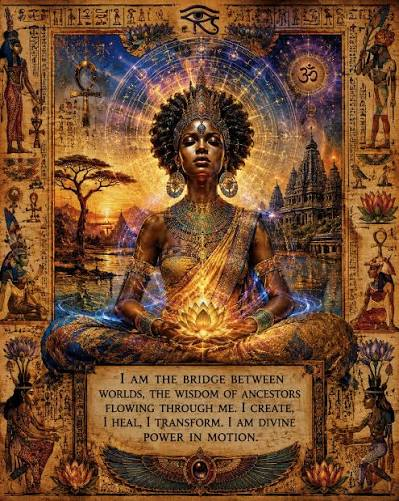
There was a time when the fields were green and the mountains appeared to touch the sky. There was a time when the forests were not merely pieces of land waiting for somebody to calculate their price. The forest was pharmacy, temple, school, market, sanctuary and ancestral archive. The birds whistled until dawn, the clouds released their waters, and the Sun returned through the rain to display the seven beautiful colours of the covenant between Light and life.
It was not a perfect world. Let us be honest, because awakening does not mean replacing a bitter lie with a sweet one. There were conflicts, rival kingdoms, injustices, mistakes and human weaknesses. Our ancestors were human beings, not spotless beings who floated above the Earth without ever offending one another. Yet they possessed systems of knowledge, government, trade, healing, agriculture, architecture, metalwork, philosophy, astronomy, art and spirituality. They observed the sky, listened to the land, studied the properties of plants and metals, raised cities, organized communities and passed wisdom through writing, symbols, initiation, apprenticeship, songs, proverbs and oral traditions.
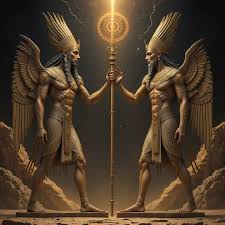
They were scientists, although they did not always wear the title scientist. They were astronomers, although no European university had framed their certificates. They were healers, metallurgists, builders, navigators, mathematicians, philosophers, priests, priestesses, farmers, artists, mothers, fathers, kings, queens and custodians of sacred memory.
They were not common men.
And when I say men, I speak here in the older sense of humanity. I speak also of the women whose knowledge fed villages, healed bodies, preserved seeds, guided births, advised rulers and carried entire civilizations in their memories. I speak of the children whose futures were interrupted. I speak of ordinary people whose ordinary labour made extraordinary societies possible.
For this is the deeper meaning of the title: they were not empty people. They were not creatures without memory who waited for foreigners to introduce them to intelligence. They were not cargo before they entered a ship, and they did not become human only after somebody baptized them, renamed them or taught them to pronounce a foreign alphabet.
History lied about them. History reduced a universe into a footnote and then asked the children of that universe why they lacked confidence. But until the lion tells its tale, the story of the hunt will continue to favour the hunter. The hunter will describe his gun in great detail and say very little about the forest. He will record the price of the lion's skin and forget that the lion had a family.
This is why we must tell the story again—not to manufacture racial pride, not to declare ourselves a “master race,” and not to exchange white supremacy for black supremacy. Supremacy is the same sickness wearing a different wrapper. We must tell the story to restore memory, responsibility and spiritual balance.
Our history did not begin with slavery.
Our ancestors were not common men—so why should we live as if we came from nothing?
1. BEFORE THE CHAIN, THERE WAS A CIVILIZATION
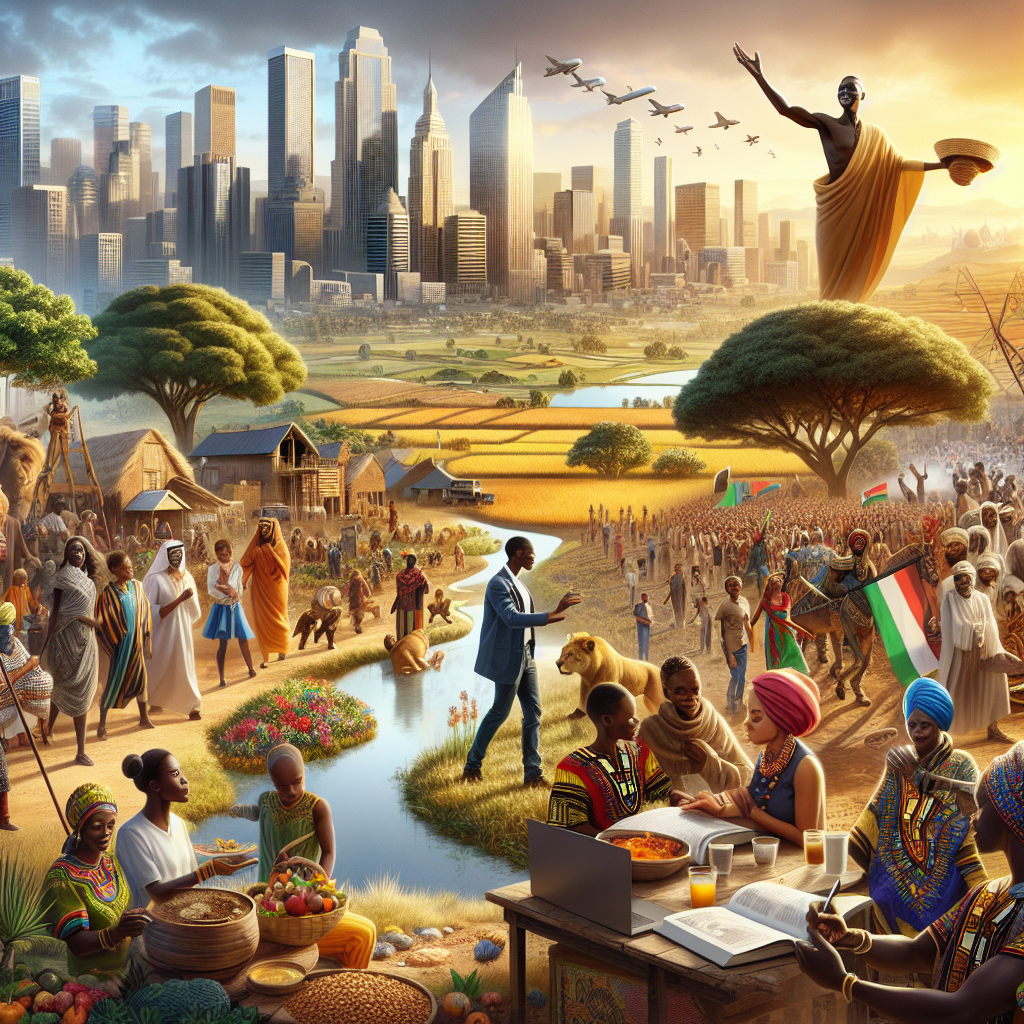
The first chain placed upon a people is not always made of iron. The first chain is sometimes a sentence: You had no history before we arrived. If that sentence enters the mind of a child and remains there long enough, the child will eventually become ashamed of his face, his name, his language and his grandmother's wisdom. He may even begin to thank the person who insulted his ancestors for giving him “civilization.” What a magnificent trick! First erase a man's house from the map, and then charge him rent for sleeping in yours.
Before the Atlantic slave trade and before European colonial rule, Af'raka contained many civilizations—not one single kingdom, not one language, not one political system and certainly not one permanently peaceful paradise. It was and remains a vast continent of peoples. Its histories differed, its nations traded and sometimes fought, its spiritual paths spoke in many names, and its knowledge developed through both local invention and exchange with other parts of the world.
But the evidence of civilization is everywhere for anyone willing to remove the dark glasses of prejudice.
Along the Nile Valley, societies studied seasons, stars, agriculture, medicine, architecture and government across long ages. In the lands of Kush, Kerma, Napata and Meroe, African states traded, built, wrote, ruled and negotiated with other powers. Aksum produced inscriptions and coinage and stood within commercial worlds joining the African interior, the Red Sea and lands beyond. Great Zimbabwe raised extraordinary dry-stone structures without the colonial engineer whom some old writers imagined must have been hiding behind every wall. Along the Swahili coast, cities such as Kilwa joined African production to the wider Indian Ocean trade.
In West Af'raka, Timbuktu became an intellectual and spiritual centre, with schools, scholars, books and debates. In present-day Nigeria, the terracottas and ironworking associated with Nok, the planned sacred city of Ile-Ife, the artistic and political civilization of Benin, and the astonishing metalwork of Igbo-Ukwu stand as witnesses. The ninth- and tenth-century copper-alloy works of Igbo-Ukwu reveal a mastery of lost-wax casting so refined that even today they can silence the loudest person who thinks intelligence must arrive with a foreign accent.
And then there is Ifa: an extensive body of sacred knowledge preserved through disciplined oral transmission, signs, verses, interpretation and mathematical patterns. Whether one approaches it as a spiritual devotee, a cultural historian or a student of knowledge systems, one cannot honestly call it the work of people without philosophy. The colonized mind may not understand an archive unless it is kept on a European shelf. Yet a trained human memory can be a library, a drum can be a messenger, a carved symbol can be a text, and a ceremony can carry cosmology from one generation to another.
Our ancestors read more than paper. They read winds, waters, leaves, stars, animal movements, dreams, seasons and the condition of the human spirit. This does not mean every traditional interpretation was correct. It means they possessed methods of observation shaped by their worlds. The true seeker does not mock ancient knowledge, and neither does the true seeker swallow every ancient claim without examination. The mystic studies, tests, reflects and separates living wisdom from human error.
That is what an awakened relationship with history requires.
We do not need to claim that Af'rakans invented every object ever touched by humanity. We do not need to say that every European lived in a cave while every African was operating a spaceship. Such stories may comfort a wounded ego for five minutes, but exaggeration is still a servant of ignorance. Civilizations have always met, borrowed, traded, translated, argued and learned from one another. The greatness of Af'raka does not depend upon making everybody else small.
The stronger truth is enough: Af'rakan civilizations contributed greatly to the human story, developed complex knowledge in many fields and did not wait for enslavement or colonization before becoming historical.
Why, then, do so many of our children grow up knowing the kings and wars of Europe better than the intellectual, political and spiritual histories of their own regions?
In Nigeria, History was marginalized for decades and removed as a stand-alone subject from much of basic education. A new History curriculum was publicly presented in 2017 after approval to separate it again from Social Studies, with plans for implementation from the 2018/2019 academic session. Yet years later the Federal Government announced its reintroduction again. Think about that carefully: a nation so forgetful that it had to remember to teach remembrance more than once.
When History disappears from the classroom, it does not disappear from life. It merely enters the hands of rumour, political propaganda, ethnic resentment, religious advertising and social-media comedians with ring lights. A child who is not taught how evidence works may accept the loudest video as revelation. A people who do not know yesterday can be sold yesterday's mistakes tomorrow with a new campaign slogan.
History is not a museum of dead dates. History is a mirror, a warning, a compass and sometimes a court of the ancestors. It teaches us what was built, what was broken, who benefited, who suffered and which patterns are quietly returning in modern clothing.
But knowing that our ancestors built great things is only the beginning. Memory that produces pride but no discipline is another form of entertainment. You can shout “I am the child of kings!” from morning until night, but if you refuse to read, build, serve, think or keep your word, the ancestors may politely ask you to stop advertising the family.
Ancestral greatness is not a chair upon which lazy descendants sit. It is a responsibility.
They were not common men—not because every one of them sat on a throne, but because they understood that the visible world and the invisible world met in human conduct. The farmer's work was sacred. The healer's knowledge was accountable to the community. The ruler was expected, at least in principle, to stand between chaos and order. Art was not always decoration; it could be memory, authority, prayer and philosophy made visible.
They knew that the Earth was not merely ground beneath the feet. She was Mother, provider and witness. They knew that the Sun was not merely a hot object in the sky. It measured time, nourished life and became a symbol of illumination. They knew that water was not merely a product to seal inside plastic. Water purified, carried, reflected and remembered.
This spiritual relationship did not make them foolish. On the contrary, it reminded them that knowledge without reverence easily becomes destruction. Our modern age can split an atom but struggles to unite a neighbourhood. It can send a message across the world in one second, yet a brother living next door cannot greet another brother because of land, politics or pride. We have faster machines, but are we becoming wiser Souls?
That is the question history places before us.
2. THE HUMAN UNIVERSES PACKED INSIDE THE SHIPS
SEE ALSO: Astra Planet Magazine: Our Sister Magazine Platform
Those who were taken away in slave ships were not common men. But we must understand this statement correctly, or in trying to repair history we shall damage it again.
The transatlantic slave trade did not systematically select only kings, scientists, astronomers and royal engineers. The captives came from many parts of society. They were farmers, metalworkers, fishermen, traders, potters, weavers, healers, soldiers, priests, scholars, political prisoners, debtors, rulers, mothers, fathers and children. Some were kidnapped. Some were captured in wars or raids. Some were condemned by courts, pawned in conditions of debt or sold through political and commercial networks. The machinery changed across regions and centuries, but the result was the same: a human being was converted into an article of trade.
To say they came from every level of society does not make the original message weaker. It makes it deeper.
The person who plants rice is not less human than a king. The woman who preserves seeds is not less valuable than an astronomer. The blacksmith who cannot write a book may nevertheless understand fire, metal, temperature and transformation in ways the bookkeeper does not. The midwife carries knowledge between life and death. The drummer carries mathematics in rhythm. The storyteller carries law, memory and moral instruction inside a tale that children can remember.
Civilizations are not built only by the famous. They are built by people whose names may never enter a palace record.
This is why the phrase they were not common men must never become an insult to common people. The deepest mystery is that there is no “common” human being. Every person contains memory, possibility, ancestry and a spark of the Universal Mind. The slave trader looked at a human universe and saw a price. Awakening means learning to see the universe again.
Imagine the coast during that terrible age. A family is divided. A name is ignored. A language is forbidden. Iron is placed around wrists that once shaped iron into tools. A farmer who understood the character of soil is sold as if he had risen from the soil without a history. A mother who knew songs for birth, grief and healing is listed beside a number. A child who might have become a teacher, priestess, inventor or ruler is packed beneath a deck.
The ship carried bodies, but within those bodies travelled worlds.
Across the Atlantic went agricultural knowledge, musical memory, ideas of the sacred, cooking traditions, healing practices, rhythm, language, resistance, craftsmanship and forms of community. Much was violently suppressed. Much was mixed with other traditions. Some was lost, some was hidden, and some survived beneath new names. The ancestral current did not remain pure and untouched; no living tradition does. It adapted. It disguised itself. It entered work songs, drum patterns, churches, festivals, foods, burial customs, spiritual practices and family stories.
The captor could rename the body, but he could not completely empty the Soul.
Many people died during capture, forced marches, confinement, the Atlantic crossing and plantation labour. Many others survived, resisted, escaped, formed communities and gave birth to descendants. To say that “they were all killed after teaching everything they knew” would erase the millions whose survival became a form of victory. Their descendants did not inherit an unbroken paradise; they inherited fragments, wounds and fire. With those fragments they made cultures that changed the world.
We must also speak honestly about responsibility.
There were Af'rakan rulers, merchants, warriors and intermediaries who participated in capturing and selling other Af'rakans. There were rivalries, wars, systems of servitude and political ambitions before European domination reached its greatest strength. To hide this is not awakening. It is cosmetic history.
But to mention African participation as though it cancels European responsibility is equally dishonest. European merchants, monarchies, companies and states built and expanded the Atlantic market, supplied ships, finance and weapons, constructed racial ideologies, organized plantation economies and turned human bondage into an enormous international system. Later colonial conquest used military power, administration, missionary institutions, economic control and racial claims to dominate African societies.
The crime had many hands, but not every hand held equal power, designed the same machinery or gained the same reward.
I therefore refuse two lazy explanations. The first says, “The white man alone did everything while Af'rakans were innocent statues.” The second says, “Af'rakans sold themselves, so Europe did nothing wrong.” Both statements are for people who want history to behave like a football match. History is not Team A against Team B. It is a field of causes, choices, structures and consequences.
The law of cause and effect does not permit us to examine only the effect we dislike. Division, greed and local collaboration opened doors. Foreign demand, capital, weapons, shipping and empire pushed through those doors and enlarged the destruction. If we point only outward, we avoid self-examination. If we point only inward, we excuse invasion. The awakened mind has enough courage to hold more than one truth at once.
And let us remove one dangerous sentence from our mouths: betrayal is not “in African blood.” No people carries treachery in its blood. Betrayal is a human choice, encouraged by fear, greed, power and systems that reward it. Every race has produced betrayers and liberators, tyrants and healers, cowards and courageous Souls. If betrayal were in our blood, unity would be impossible. If it is a pattern of choices, then new choices can break it.
This is the spiritual lesson hidden within history.
Karma is not a racial curse. Karma is the movement of cause into consequence. When leaders sell the future for personal comfort, the children inherit debt. When a community despises knowledge, fraud becomes attractive. When people abandon one another, outsiders do not need supernatural powers to control them. But when people restore trust, discipline, memory and shared purpose, another current begins.
The ancestors are not asking us to remain angry forever. Anger can wake a sleeping person, but it cannot build a house. You may use anger to rise from the floor, but if you make it your permanent home, you will simply become a prisoner in a room built by the enemy you claim to hate.
Our duty is not to hate the descendants of those who committed crimes. Our duty is to understand the system, repair what can be repaired, demand justice where justice is due, reject racism and ensure that we do not reproduce domination among ourselves.
The hunter's lie is defeated not when the lion becomes another hunter, but when the lion learns to speak, remember and guard the forest.
3. WHEN THE ROOT WAS RENAMED EVIL
Physical enslavement seized the body. Mental and spiritual enslavement attempted to make the captured person distrust the source of his own being.
One of the deepest wounds in Af'raka is not simply that foreign ideas arrived. Ideas have always travelled. Christianity existed in parts of Af'raka long before modern European colonialism, just as Islam entered African societies through varied histories of trade, scholarship, migration, politics and conquest. Af'rakans also interpreted, transformed and Africanized these religions. The story is more complex than saying that every believer was merely hypnotized by a foreigner.
The true problem begins when power says: Only the foreign name is holy. Your name is darkness. Your ancestor is a demon. Your language is backward. Your sacred grove is evil. Your drum is noise. Your knowledge is superstition. Your body must be ashamed of itself. Your salvation begins when your memory ends.
That is not spiritual liberation. That is conquest entering the inner temple.
We first lose a civilization in the mind before we lose it on the map. Once a person believes that everything connected to his roots is inferior, he will destroy his own inheritance for free. Nobody will need to force him. He will proudly do the work and call it deliverance. He will cut down the sacred tree, burn the archive, laugh at the old woman who knows the plants, rename the child and then donate money to celebrate his disconnection.
Very efficient. The chain now has a willing security guard.
But returning to our roots does not mean bowing blindly before everything our ancestors did. An ancestor is not automatically perfect because he is dead. Some ancestors acted wisely; some acted foolishly. Some traditions protected life; others may need examination, reform or abandonment. Spiritual maturity is not the worship of the past. It is the ability to receive inheritance with discernment.
To honour an ancestor is to remember, learn and continue what gives life. It is to correct what caused harm. It is to understand that we too are becoming ancestors through our present choices.
Think of that carefully. One day your photograph may be the old picture in somebody's room. One day your name may be called during a family story. One day your descendants may ask what you protected, what you destroyed, what you built and what you sold. If you spend your life insulting all ancestors, kindly remember that you have already submitted your application to join them.
The ancestral realm is not merely a crowd of invisible people waiting to receive gin. At a deeper level, it is the living field of memory, consequence and pattern from which a community continues to grow. We inherit biology, language, wounds, habits, songs, land disputes, gifts, fears and unfinished work. What one generation refuses to heal often returns as the confusion of another generation.
This is why the tree is one of the greatest spiritual symbols. The branches may face many directions, but they drink from a hidden root. If the branch becomes embarrassed by the root, it may still look green for a short season. Eventually the disconnection reveals itself.
Our present disconnection reveals itself in many ways.
It appears when material wealth becomes the only measure of human worth. Money is not evil. Poverty is not holiness. A people must build wealth, industries, farms, laboratories, schools and secure homes. But wealth without Soul becomes appetite without end. A person buys one car, then another car, then a third car to prove to the second car that progress has occurred. Meanwhile, his workers remain unpaid and his community has no clean water. He calls this blessing. The ancestors may call it poor accounting of the spirit.
It appears in our politics. Many candidates promise to change the nation, but when power enters their hands, ego enters the room before them and locks the door. The leader who once called the people his family begins to see them as a crowd useful only during elections. He blames colonialism in the afternoon and signs another selfish contract before dinner. Yes, external powers still influence African economies and politics. But a puppet requires somebody willing to wear the strings.
It appears in the commercialization of religion. A pastor, imam, priest or spiritual worker may need material support; buildings, staff, charity and community work cost money. The question is not whether a congregation may give. The question is whether giving has become a marketplace of fear: Pay this amount and Heaven will notice you. Buy this oil and your enemy will catch fire. Sow a special seed and the Universal Intelligence will finally remember your address.
Does the Omnipotent need cash, or does an institution need honest funding? Let us name things correctly. The Infinite is not poor. If money is collected, let there be transparency, service and compassion. Salvation is not a product, and the microphone is not an automatic certificate of wisdom.
Disconnection also appears in the way we wound the feminine and masculine principles of life.
Consumer culture can teach a young woman to measure her value by what a man spends on her. The same culture can teach a young man to measure manhood by how many women he controls or conquers. These are not African essences; they are wounded patterns. A woman is not a purse-seeking body, and a man is not a walking wallet with authority over another Soul. There are exploitative women and exploitative men, faithful women and faithful men, confused women and confused men. Awakening must not use one gender as the dustbin for society's failures.
The feminine essence carries intuition, nurture, creation, receptivity and fierce protection. The masculine essence carries direction, structure, protection, action and focused will. These principles can move through every person in different ways. When either becomes domination, manipulation or selfish appetite, imbalance enters the home. When both meet in respect, truth and responsibility, a household can become a small temple of civilization.
Our young people feel the consequences of this imbalance. Some carry unemployment, family pressure, loneliness, violence, disappointment, historical shame and a future that appears closed. Some attempt to numb pain through drugs and harmful alcohol use. Some become depressed. Some develop suicidal thoughts.
We must not turn this pain into another opportunity for spiritual pride. Depression is not proof that a person's vibration is dirty. Mental illness is not always solved by telling somebody to pray harder, “be a man” or remember that the ancestors were strong. The ancestors used healers, community, ritual, rest, herbs, counsel and practical care according to the knowledge available to them. In our time, responsible care may also include trained mental-health professionals, medicine, crisis support, family protection and freedom from shame.
A person in suicidal crisis needs immediate human and clinical help, not an argument about whether sadness is spiritual. Light Workers must learn that sometimes the most spiritual act is to sit down, listen carefully and help a person reach qualified care.
There is no contradiction between spiritual restoration and practical treatment. The Soul may seek meaning while the brain and body require care. We are multidimensional beings living through physical vessels. To neglect the vessel while preaching about the Soul is like refusing to repair a leaking roof because the sky is eternal.
Our ancestors were not common men, but they were also not magical excuses for us to avoid work. They planted before harvest. They apprenticed before mastery. They watched before interpretation. Today somebody attends one weekend seminar, opens a social-media page on Monday and becomes “Grand Master of the Seven Galaxies” by Tuesday. Then we wonder why seekers are confused.
The root demands discipline.
To return to the root is to learn our languages, because language carries worlds of thought. It is to record our elders before their libraries close. It is to preserve sacred sites and natural environments. It is to study history with evidence. It is to learn the sciences without believing that science belongs to one race. It is to study spiritual traditions without turning every mystery into a business. It is to honour the Divine within without surrendering the reasoning mind.
The root is not a costume. The root is consciousness.
4. IF THEY WERE NOT COMMON, WHY SHOULD WE LIVE COMMONLY?
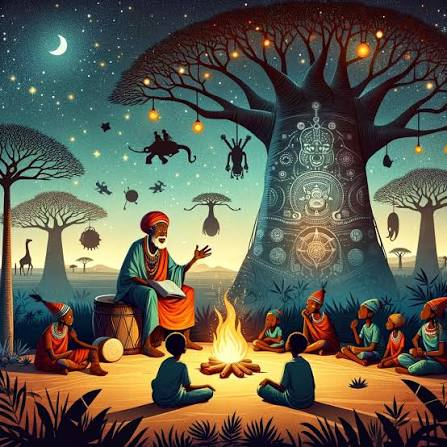
I now return to the question that burns beneath this article:
If our ancestors were not common men, why should we?
To live an uncommon life does not mean becoming famous, rich or superior to your neighbour. Fame is not evidence of evolution. These days, a person can become famous because a camera caught him arguing with a goat. The algorithm may crown him before sunset. Let us therefore stop confusing visibility with value.
An uncommon life is a conscious life.
It is the life of a person who refuses to remain mentally asleep. It is the life of a person who studies before shouting, examines before blaming and acts before demanding miracles. It is the life of a person who knows that freedom without responsibility becomes another prison.
We say we want to change Af'raka, but many of us have not learned to spread a bed, keep an appointment, honour an agreement, read a complete book, dispose of waste properly or treat another person with dignity. Then we enter the internet to announce our plans for continental liberation. My brother, begin with the room. My sister, begin with the promise you made yesterday. The Universe is not deceived by large grammar.
How we spread the bed is often how we shall rest upon it.
Change begins within, but it must not remain within. Inner awakening that produces no outer service is only private decoration. If meditation makes you peaceful but your workers remain unpaid, perhaps you met sleep, not enlightenment. If ancestral knowledge makes you proud but cruel to your wife, husband, child or neighbour, you have collected information without receiving wisdom. If spirituality makes you despise everyone outside your path, you have simply given ego a sacred uniform.
The real sign of awakening is not the number of mystical words in your speech. It is the quality of your conduct.
Can you tell the truth when a lie would reward you? Can you return what does not belong to you? Can you cooperate with a person from another ethnic group? Can you protect a woman without controlling her? Can you respect a man without worshipping his money? Can you disagree without becoming an enemy? Can you lead without eating the future of those you lead?
This is where civilization begins again.
Af'raka does not need only another generation of people who praise the past. Af'raka needs builders who can translate memory into institutions. We need historians and archivists who will gather evidence. We need teachers who can make a child excited about local history without teaching hatred. We need engineers who understand the environment they are building within. We need physicians and psychologists who respect culture while using tested knowledge. We need farmers supported by research, fair markets and modern tools. We need artists who carry memory forward without becoming prisoners of imitation. We need ethical entrepreneurs, accountable leaders and spiritual teachers who do not sell fear.
We need families that tell children where they came from without deciding in advance who those children must hate.
We need museums, libraries, laboratories, community archives, restored manuscripts, protected languages and digital records. We need to study stolen objects, request their return where justice demands it, and build institutions capable of preserving them when they come home. We need to protect forests, rivers and sacred landscapes—not because every tree contains an angry spirit waiting to punish us, but because a people who destroy the lungs and waters of their home are performing a slow ritual of self-harm.
We need unity, but unity does not mean uniformity. Af'raka is not one voice. Yoruba need not become Igbo; Igbo need not become Akan; Akan need not become Shona; Shona need not become Maasai. Unity is not the burial of difference. It is the wisdom to protect common dignity while differences remain alive.
We also need to release ourselves from the theatre of endless blame.
Colonialism was real. Slavery was real. Racial exploitation was real. Their consequences did not disappear because a flag was raised and an anthem played. Present international systems can still carry inequalities shaped by that past. We must study these things clearly, organize intelligently and demand justice.
But if every broken streetlight, stolen public fund, abusive relationship, unpaid worker and dishonest transaction is placed at the feet of a European who has never visited our street, then blame has become a spiritual sedative. External domination survives more easily when internal irresponsibility refuses to look in the mirror.
The question is not merely, Who wounded us? The question is also, What are we doing with the wounded place?
A scar can become wisdom, or it can become permission to wound others.
Our restoration must not become racism. The aim is not to reverse the seating arrangement on the same throne of supremacy. We do not rise by proving that another race is naturally beneath us. Spirit has no skin. The Soul reincarnates beyond the borders that human beings defend with so much noise. The Divine Spark does not become more Divine in a lighter or darker body.
We are children of the Sun, but the Sun does not shine upon only one tribe.
This does not mean pretending that injustice is an illusion. Oneness without justice becomes a slogan used to silence the wounded. It means confronting injustice without surrendering our humanity to hatred. Light is not weakness. Compassion is not forgetfulness. Forgiveness is not the cancellation of accountability. An awakened people can remember the wound, seek repair and still refuse to become the poison that harmed them.
Today is here. Tomorrow has made no promise to arrive. Take your chances here and now.
Study one piece of your history beyond a social-media caption. Learn the proper meaning of your name. Ask an elder a question and record the answer—with permission. Support a local craftsperson. Read an African scholar. Learn a language your family nearly lost. Plant a tree. Help a child remain in school. Build something honest. Refuse a bribe. Pay a worker fairly. Seek treatment when your mind is in pain. Apologize when you are wrong. Protect your body. Honour your word.
These acts may not trend, but civilizations are often repaired by things cameras do not notice.
The ancestors do not need us merely to defend them in arguments. They need descendants whose lives make remembrance meaningful. What honour is there in pouring libation to a courageous ancestor while behaving like a coward? What honour is there in wearing ancestral symbols while stealing from the community? What honour is there in shouting that our forefathers were scientists while we mock education, evidence and patient study?
Do not inherit only their names. Inherit their hunger for knowledge.
Do not inherit only their crowns. Inherit their duty.
Do not inherit only their shrines. Inherit their reverence for life.
Do not inherit only their wounds. Inherit their capacity to survive, adapt and create.
They were not common men. They were human beings standing within the mystery of existence, answering the challenges of their age with the knowledge available to them. Some answered wisely. Some answered poorly. The same examination is now before us.
We are not being asked to return physically to yesterday. No river carries the same water twice. We are being asked to retrieve from yesterday the principles that can build tomorrow: memory, discipline, community, courage, inquiry, spiritual balance and respect for life.
Af'raka, the time has come to rise—not into empty pride, but into responsibility.
Rise and study. Rise and remember. Rise and build. Rise and heal. Rise and become the ancestors you wish you had.
For the tree that completely disconnects itself from its root may remain standing for a while, but it has already begun to fall. Return, therefore, not to remain beneath the old tree forever, but to receive the strength to plant new forests.
Hear the voice of wisdom. Honour your ancestors without surrendering your reason. Embrace your root without hating another person's root. Open the inner eye, discipline the outer hand and let your awakening become useful to the world.
Our ancestors were not common people.
And neither is any Soul who remembers why it came.
MAN, KNOW THYSELF.
AF'RAKA, REMEMBER WHO YOU ARE.
Best wishes, with Love and Light.
Written by Knight Fredel © 2019–2026
ALSO READ: FINGER-POINTING IS NOT THE WAY: THE HAND THAT ACCUSES CANNOT REBUILD AFRAKA – By Knight Fredel
CLICK HERE
Editorial Reference Points
- UNESCO: General History of Africa and the African Renaissance
- The Metropolitan Museum of Art: Arts of Africa—ancient civilizations, Nok, Ile-Ife, Benin, Aksum and regional histories
- The Metropolitan Museum of Art: Igbo-Ukwu and early West African copper-alloy work
- UNESCO Intangible Cultural Heritage: Ifa Divination System
- UNESCO World Heritage Centre: Timbuktu
- UNESCO World Heritage Centre: Great Zimbabwe National Monument
- UNESCO: Slave Voyages—The Transatlantic Trade in Enslaved Africans
- Nigerian Educational Research and Development Council: presentation of the new History curriculum
- CDD Fact Check: the history of History as a stand-alone subject in Nigerian schools
- World Health Organization: mental health, substance use and suicide prevention
Reader-care note: If you or someone near you may act on suicidal thoughts, seek immediate in-person help from emergency services, a hospital or a qualified crisis professional. Do not remain alone with the crisis.