THE LOST VOICE OF ANARCHA: THE MOTHER OF GYNECOLOGY
Imagine a world in which your screams become textbooks. In which your pain is footnoted; and then forgotten. In which your body, torn and bleeding, is the soil in which “progress” grows. That world was real. That world had a name. The name was Anarcha.

Written By Knight Fredel
ISSUE 97
⚠️ Strong Content Warning: Awake Afraka Advisory:
The history explored in this article contains uncomfortable truths; including medical exploitation, racial degradation, and scenes of human suffering. These realities are painful but necessary to confront. Readers who are sensitive to graphic or disturbing material should proceed with awareness.
A World Built on Screams — The Resurrection of Anarcha
Imagine a world; yes, close your eyes if you must—where your screams become classroom material.
Where your agony is cited in academic papers with calm, polite footnotes.
Where your blood becomes “research,” your pelvis becomes a “case study,” and your suffering becomes the fertilizer from which “scientific breakthroughs” sprout like shameless weeds.
Imagine a life where the moment you howl in pain, someone in a lab coat (or in this case, a dusty 19th-century frock coat with ego stitched into the lining) scribbles notes and says,
“Excellent. Tell me when it hurts again.”
A world where a human body, your body is torn, stitched, torn again, forced open, swollen, violated, and bleeding; becomes the soil out of which modern medicine grows like a proud sunflower that refuses to admit the dirt beneath it.
Now stop imagining.
Because that world existed.
It had a pulse. A whip. A surgeon’s table.
It had a villain dressed as a genius.
And it had a name; Anarcha.
Today, the polished wooden lecterns of medical schools still clear their throats and recite, with frightening confidence, the title:
“Dr. J. Marion Sims, Father of Modern Gynecology.”
Father?
Sir, if you are the father, then who is the mother?
And why was she never invited to the graduation ceremony?
He did not “invent” modern gynecology.
He harvested it; from bodies he owned.
He extracted it; from women who could not say no.
He stitched it together; literally, on the torn flesh of enslaved Black women.
Among them stands a figure so haunting she seems carved from ancestral smoke: Anarcha Westcott (sometimes recorded as Westcott Jackson), a teenager forced into medical martyrdom.
Her story?
Half myth, half archival scraps, half whispered legend passed down the hallways of history, but entirely ours to excavate like sacred ruins.
And before anyone clears their throat to say, “But medicine advanced”.
Yes, it advanced.
The question is: on whose broken spine did it climb?
This is not a gentle biography, written with academic politeness and neutral tones.
This is a summoning.
This is a reckoning wearing iron sandals.
This is history grabbing the collar of the present and saying:
“Look at what you inherited. And look at who paid for it.”
So, sharpen your mind like a shovel, dear reader.
We’re digging deep, irreverently, fiercely.
Not to desecrate the past, but to resurrect what was buried under marble statues and selective memory.
My name is Knight Fredel Ijere. And I am your Mystery Teacher... So, I welcome you to Awake Afraka Magazine. The world of Truth. Arcane Gnosis. Spiritual Awakening and Cosmic Enlightenment.
Now that you're all settled... Let us descend into the rabbit hole of truth.
The Silencing of Her Name
When History Pretends Not to Know You
Anarcha does not merely “disappear” from official records; she vanished; deliberately, methodically, with the quiet efficiency of a secret police unit that specializes in erasing inconvenient Black women from history. Her name flickers faintly in footnotes, as if history were whispering her existence under its breath, embarrassed to admit what it has done. And when a name appears only in the fine print, it means one thing: someone wanted it out of the headline.
That absence is not an accident. It is a rhetorical strategy.
A literary sleight of hand.
A silencing disguised as “insufficient documentation.”
The historical version of looking directly at someone, then pretending you didn’t see them.
The name “Anarcha Westcott” surfaces only through a narrow keyhole: Dr. Sims’s own self-congratulatory memoirs, where her voice is muted beneath his ego, and through the obsessive detective work of scholars like J. C. Hallman, who chased her ghost through archives that barely cared enough to write her name correctly.
From these scraps, one can assemble a haunting silhouette:
A girl likely born around 1828, on or near the Westcott plantation in Alabama, a place where humanity was measured in coin and counted like livestock. At roughly seventeen, in 1845, she endured what would become the first of thirty-plus experimental surgeries performed without anesthesia, because Dr. Sims believed Black women did not feel pain the same way white women do.
(Trust me when I say; Every woman alive today felt a sharp spiritual slap reading that sentence.)
Those few documented lines; so thin, so skeletal, are merely the surface gloss. Beneath them lies a labyrinth of brutality:
the plantation machinery that ground her life into labor,
the traders who evaluated human beings the way farmers examine mules,
the so-called “science” that treated her teenager’s body as raw material,
and the societal silence that wrapped the whole nightmare in a comfortable hush.
And in speaking Anarcha, we drag the old world by its collar into the light.
The Plantation and the Traders: Who Owned Anarcha?
We do not know her parents’ names. We do not know where she was born before becoming a property, except for the reconstructed stories created for their official records. But we know the chains she walked in. In one account, she was “given to William R. Westcott,” the second-oldest son of the Westcott family, making him her “third owner.” A document in 1841 lists her as “Anarcky,” aged 13, valued at $500. That would make her a lucrative commodity in the trade of human flesh, most especially at that era.
So, already we see a pattern: birth, sale, transfer, devaluation. The plantation economy trafficked in her body before any doctor ever touched it. Her very name is tied to the family that claimed her: Westcott.
We do not (yet) have a distinct record of her being bought in a slave market at auction. Perhaps she was inherited, perhaps outright purchased; the archival record is silent on such reports. Yet the silence speaks a volume: it was not uncommon for enslaved children to be parted from their mothers, valued, catalogued, and transferred with bookkeeping precision. The warehouses for human bodies had ledgers; Anarcha’s may well have had multiple entries, none of which she ever saw.
On that Westcott plantation in Alabama; on the same soils that yielded cotton, on the same fields haunted by whips and lash; Anarcha grew up. She became a mother, she labored, she carried wounds both visible and invisible.
June 1845: The Labor That Tore Her
Let’s get concrete. One summer day in June 1845, a 17-year-old enslaved woman named Anarcha lay in labor; or rather, agony. According to multiple historical reconstructions, she endured 72 hours of labor before Sims was called in to assist with forceps. That labor was not the noble birthing of a hero; it was violent, crushing, brutal. After the baby was delivered (or in some accounts died), her pelvic tissues were torn. Her vaginal walls and bladder connection (vesicovaginal fistula) had been ruptured.
In that moment, she was no longer a mother or a woman; she became a medical case, a “defect,” a hemorrhage, which is a medical term for bleeding that occurs when blood leaks out of damaged blood vessels. It can be classified as internal, such as bleeding within the body (e.g., in the stomach), or external, such as bleeding from a cut on the skin.
Dr. Sims showed up not to offer comfort or care, but to take advantage of her situation. He saw her injury as nothing more than a chance for research. He had started his career as a “plantation physician,” treating enslaved people as part of his work. But the birth that left Anarcha’s body broken marked the beginning of many harsh experiments he would go on to perform.
The Theatre of Torture: Experiments Without Consent
Talk about scientific irony; the so-called “father of gynecology” earned his reputation through medical procedures done without anesthesia and without consent.
Hidden historical records reveal that between about 1844 and 1849, Dr. Sims carried out experiments on at least twelve enslaved Black girls and women, though only three names; Lucy, Betsey, and Anarcha, are remembered today. Reports indicate he leased some from their enslavers and, in at least one instance, purchased a woman outright for surgical procedures, whom I am guessing was Anarcha. These women were regarded as specimens rather than patients.
One scholar wrote:
“He manipulated the institution of slavery to perform ethically unacceptable human experiments on powerless, nonconsenting women.”
In Dr. Sims’s America, Black women were considered legal non-persons, viewed as non-human and treated as property, so he only needed consent from their owners, not from them.
The surgeries were repeated, cruel, and often unproductive. According to the New York State Archives’ narrative, Sims performed at least 30 surgical attempts on Anarcha alone. Harvard’s Gazette article notes that Anarcha endured “at least 30 surgeries” as Dr. Sims attempted to repair her vesicovaginal fistula. Many of those surgeries failed, infected, reopened; she was stitched up again and again.
Dr. Sims did not use anesthesia on these women, and that was because of a combination of risk beliefs, surgical custom, and racist assumptions that Black women felt less pain. In the medical journals, he framed the operations clinically, not recounting the screams he must have heard. He never referred to the women as women; they were “cases,” “defects,” “repairs.” The audience of doctors would gather round to observe these experiments. Surgical spectators watched a naked, writhing Black woman under restraint while Dr. Sims worked. In one case, he left a sponge in a patient, provoking sepsis.

One failed surgery after another, the reports kept piling up. Still, he pressed on, framing his efforts as dedication, a noble sacrifice for science. All the while, the real pain and struggles of those women were reduced to footnotes; or left out entirely.
It’s a grim irony that the progress praised in medical schools and textbooks is stained with her blood.
Anarcha the Co-Investigator? The Question of Agency
Some defenders of Dr. Sims’ legacy argue that his patients (including Anarcha) became willing participants, or even “assistant” operators as their health improved. Yet that argument is ethically fraught. These were enslaved women forced to cooperate, under duress, in a context of power imbalance, violence, and zero autonomy.
Here, another source emphasizes:
“It is important to remember that they had no choice.”
Yes, in some later operations, Dr. Sims claimed to train them to assist in their recovery or in subsequent surgeries. But that “training” is offered under the condition of powerlessness. The “consent” he claims cannot be disentangled from the coercion of slavery.
Nevertheless, the idea that the victims are co-authors of their own erasure is a rhetorical sleight-of-hand. The complicity narrative is a smokescreen to obscure unequal agency.
So, yes: Anarcha may have aided in post-op care or assisted other patients under Sims’s direction. But to call that “consent” is to rewrite the ledger of power.
Success, Fame, and Omission
By 1849, Dr. Sims published the technique that he claimed succeeded in closing vesicovaginal fistulas; the techniques he tested on those enslaved women. In 1852, he published an article on his method, omitting the fact that his patients were enslaved Black women. Instead, he illustrated white women, with a white nurse. Simultaneously, those same women; Anarcha, Lucy, Betsey, were returned to their enslavers after years of experimental residency. They were denied credit, denied voice, denied legacy. They lost their own voice to speak out, because no one would listen.
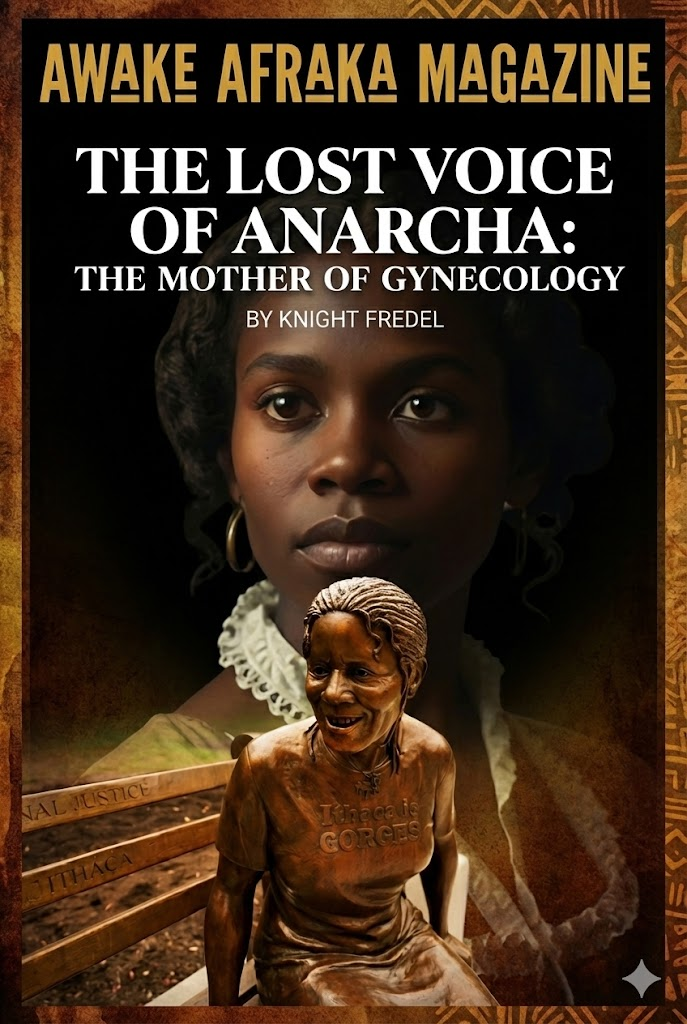
Dr. Sims, meanwhile, became lionized. Hospitals, chairs, statues were erected in his honor. The scholarly pendulum has since swung. In 2018, New York’s statue of Dr. Sims was removed from Central Park after activism and pressure. In 2021, a new “Mothers of Gynecology” monument was unveiled in Montgomery, Alabama; depicting Anarcha, Lucy, and Betsey (crafted from discarded metal to evoke brokenness and resilience). Slowly, the memory creep is turning toward justice.

The omission is instructive: progress narratives prefer their heroes clean, sanitized, unblemished by the mess of history. The mess is always someone else’s wound.
SEE ALSO, OUR PREVIOUS EDITION
Why Does This Matter?
This may sound like a history; but it is a "hint" of our past.
This is not museum skeletons. This is not a faint sob in an academic journal. It matters because her story is alive; in the anatomical textbooks, in women’s surgeries, in reproductive inequity, in trauma, in mistrust.
1. Medical Racism Is Not Past Tense
The legacy of surgical experimentation without consent did not die with Dr. Sims. The trope that Black patients feel less pain lives on in studies showing that Black patients are undertreated for pain or believed to have “higher pain tolerance.” The history of medical exploitation of Black women is not a side note; it is foundational.
2. Memory and Monuments Matter
When statues celebrate Dr. Sims without acknowledging Anarcha, that is rhetorical violence. Naming matters. Commemorating her with the “Mothers of Gynecology” monument is an act of rhetorical repair. When the public discourse says, “he discovered,” we must insist he stole a discovery from the bodies of Black women.
3. Agency, Consent, and Bioethics
In bioethics classes, you talk about informed consent. But can you have genuine consent in a system that treats you as property? We must rethink how we teach ethics, how we memorialize victims, how we repair not just memory but policy. Medical schools cannot merely relegate this to a footnote in the syllabus—they must interrogate their foundation.
4. Gender, Race, Reproductive Justice
Enslaved women’s reproductive capacities were sites of accumulation; new slaves, returning profit, forced breeding. When Anarcha’s birth tore her body, it was not an accident, it was in the logic of an economy that insisted on reproduction as revenue.
Her story is feminist, Black, medical, and it is human.
The Final Surge: In Her Own (Reconstructed) Voice
If I may, I’d like to offer a reimagined monologue, weaving together what we know and gently filling the gaps with empathy.
I was born in the shadow of cotton rows and slave shacks. My name was chosen for me, and later, forgotten.
At seventeen I bore a child, but the land took her too. My body broke. They called me “defect.” A white man came; a doctor without mercy, without apology. He pressed metal into me. He cut and calibrated. He watched me scream.He never asked me to sign papers. He did not seek my permission. He asked the plantation owner. He brought other men as audience.
Thirty times, I sat at the knife’s theater. Thirty times, I woke to new wounds. But I lived. I endured.They published their triumph; but I was nowhere in the pages. Yet my flesh made that triumph possible. My scars became surgical technique. My pain taught them closings, sutures, wire.
But that does not mean I consented.They named a statue after him. I remain unnamed.
But I remember. And so, must you.
Now, those where her words; but I cannot guarantee she ever thought or spoke those precise words; but the lines are not lies. The erasure is real. The trauma is real. And the legacy is ours to reclaim.
Conclusion
Calling Out the Global Amnesia Problem
In our present age; an era where institutions perform “reforms” with the same enthusiasm a lazy student uses to rearrange his bedroom without actually cleaning it, some medical schools are finally side-eyeing their sacred eponyms. A few statues have been quietly escorted off campus lawns like disgraced celebrities leaving court. Committees have met. Plaques have been swapped. A handful of professors are sweating under the collar.
But let us be brutally honest, shall we?
Scraping a name off a metal plate is not justice; it is housekeeping. A moral surface-wipe. The intellectual equivalent of spraying air freshener into a room that still has a corpse in it.
The real task is larger; messier and bold enough to frighten fragile academic hearts. We must restore names to bodies, to memory, to curriculum, to consciousness itself. We must turn ghosts back into people.
And Anarcha; yes, she deserves far more than a polite mention in a footnote or a pity paragraph in a dusty textbook. She deserves a syllabus. She deserves entire departments arguing passionately over her legacy. She deserves symposiums, conferences, documentaries, statues that actually look like her, and textbooks that say her name without flinching like scared toddlers.
If medical schools can name auditoriums after men who experimented on women without anesthesia, then surely Anarcha can at least get a hallway; preferably one that doesn’t smell like formalin.
And before anyone says it:
No, this article is not frivolous. It may be irreverent, yes, intentionally so, but irreverence is simply the spice used to season bitter truth. Humor is my cane, sarcasm my scalpel. We wield them not to trivialize, but to expose.
Because let us say it plainly:
There is a pattern; oh yes, a global pattern, where the Western world develops a sudden, mystical case of selective memory. A habit of adopting ancient knowledge, polishing it, and then boldly announcing, “We discovered it!”
Wait...! Really?
You?
Discovered?
The thing you learned from someone else?
Call it the greatest intellectual magic trick in history: African contributions disappear, and a European reappears holding a patent.
Democritus?
Ah yes; presented as the “father” of democracy. Meanwhile the man literally studied in Africa, copied the notes, travelled home, and said, “Ladies and gentlemen, behold my new idea!”
Sir, the only thing you discovered was the road back to your village.
And the Hippocratic oath in the medical academics?
Yes, the one sworn by doctors everywhere with such seriousness you’d think it descended from Mount Olympus itself.
For those who do not know:
The Hippocratic Oath is an ethical code attributed to the ancient Greek physician Hippocrates, traditionally believed to have lived between 460 and 370 BC. It outlines the responsibilities of physicians, emphasizing principles such as beneficence (acting in the best interest of patients) and non-maleficence (avoiding harm to patients).
Yes. That oath, and the ancient medical knowledge that came with it; was not birthed in Greece. It came from the Ancient African Mystery School temples, where science and spirit walked hand in hand long before Europe figured out what bathing was.
Well, when they did, they choose to rewrite the scrolls...
Rename the gods...
Rebrand the formulas.
Which seems to be their global pastime hobby.
Rumor once had it that medical authorities were considering a mild “revision” of the oath; because, well, the truth about its African origin was beginning to leak out like a guilty secret. No wonder the Alexandra's Library and other Kemetic Libraries were burnt in the name of some strategic wars to conceal the truth.
And then there’s that precious line in our old school textbooks:
“River Niger was discovered by {insert heroic European traveler with a curious hat}.”
Ah yes, discovered. As if the river sat quietly for centuries, hands folded, waiting for a white man to arrive and say, “Behold! Water!”
Meanwhile, our ancestors literally fetched water, fished, bathed, farmed, worshipped, travelled, and built communities around it long before the explorer even bought his ship ticket.
So is Africa hated?
Is Africa deliberately pushed into the shadows?
Dragged behind the global curtain?
The answer hangs in the air like smoke; but the real crime is the silence.
Because peace should be desired; not the polite, diplomatic peace, but the courageous one. The peace that comes when truth is acknowledged, when racism collapses under the weight of honesty.
Okay... One more thing; on the subject of Anarcha, let us be final and firm:
Every woman who steps into a gynecologist’s office today, every single one, stands on the bones, the suffering, the forced endurance of Anarcha and the women like her. So, remember her...
Those bones are not quiet.
Those bones are not passive.
Those bones demand... no, command; to be heard.
Name her efforts.
Teach her history to your offsprings.
Honor her sacrifice.
And... Reckon with her.
For history is only healed when the forgotten are restored; and the stolen are returned to the rightful storytellers of their legacy.
Written By Knight Fredel Ijere
Meta-physicist | Mystery Teacher | Author
SEE ALSO, SIMILAR HISTORY. Forgotten, Concealed, and Trashed

WHO EXACTLY WAS SARA BAARTMAN? BY Knight Fredel
- Her name was. Sara Baartma. Born in 1789 in the Eastern Cape Town of modern-day South Africa, she was well known because of her famous large buttocks, She was exhibited as a freak show attraction in the 19th century Europe.
Sara Baartman’s large buttocks and unusual coloring made her the object of fascination by the colonial Europeans who presumed that they were racially superior to the black race and therefore can use any black of their choice as an object of amusement and caricature. So bad and so sad.
All Rights Reserved; Awake Afraka Magazine © 2025